
Last Updated: September 2, 2026
Now robots are becoming an increasingly influential part of our daily lives. From production floors to sci-fi blockbusters, robots are now implemented in countless domains, including manufacturing, health care, logistics, home, agriculture, personal assistance and travel. As robot technologies continue to evolve, their integration into society is only expected to accelerate-from transportation to space exploration.
The rapid advancements in robotics and AI have contributed to the rise of intelligent machines. The capabilities of sensors, computer vision, machine learning, batteries and connectivity have led to machines gaining a better grasp of their surroundings with relatively limited human intervention.
The development and adoption of robotic systems are directly proportional to the need of industrial automation, digital transformation, productivity, security, safety and eco-friendliness of the future. Humans employ the use of robotics in performing routine and hazardous jobs, for cleaning, entertainment, security systems, etc.
But what exactly is a robot? What are the major types of robots, and how are they different from one another?
This guide explains the major categories of robots in simple language, along with their applications, advantages, limitations, and future trends.
This Article Belongs to Robotics and Automation
Table of Contents
What is a Robot?
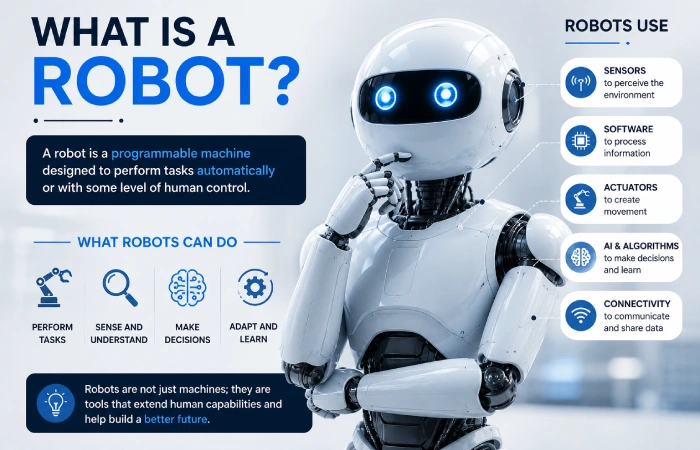
A robot is an automatic, machine-programmable machine that executes certain jobs. A robot can take in information from the surrounding environment, process information and make decisions according to the collected data; control human beings, travel under controlled command and manipulate objects within specified ranges.
A robots usually combines several important technologies, including:
- Sensors to collect information from the environment
- Software to control its actions
- Motors and actuators to create movement
- Processors to handle information
- Cameras or other vision systems
- Artificial intelligence for perception and decision-making
- Communication technologies for connecting with other devices or systems
A robots may not appear like a person. As an example, most robots do not look like individuals. A factory robotic arm, a mobile warehouse robot, a surgical system, a Mars rover are all examples of robotics robots.
How Are Robots Classified?
Robots are not standardized in any specific way, meaning that robots can be classified into various groups based on many features, such as their mode of operation, purpose, control methods, physical makeup and their operating environment.
For example, a robot can be classified as:
| Classification | Examples |
| By movement | Wheeled, legged, flying, underwater |
| By application | Industrial, medical, consumer, agricultural |
| By control | Remote-controlled, semi-autonomous, autonomous |
| By environment | Indoor, outdoor, underwater, space |
| By physical design | Robotic arm, mobile robot, humanoid robot, drone |
This implies that one robot could be placed into multiple categories at the same time. A robot can act as a warehouse robot (industrial and autonomous).
Five Major Types of Robots
Robots take many different forms but the following categories give a simplified understanding of the primary forms and their usage.
1. Robots Based on Locomotion
The concept of robot locomotion defines the method the robot uses in order to change its location. Various locations demand other ways for displacement, robotic as for natural forms
Wheeled Robots
Wheeled robots are machines with wheels designed to move along surfaces. They can be fairly simple to build, and they move well across smooth floors.
They are commonly used in:
- Warehouses
- Hospitals
- Factories
- Security systems
- Delivery services
- Domestic cleaning
Automated warehouse robots have the ability to take goods from one place to another without the necessity for the use of cart pushes to transport them.
Legged Robots
Legged robots have two or more legs and are mainly used for move. As a huge advantage, these robots can traverse a wider variety of uneven terrain, stairs, and environments than wheeled robots could manage. Quadruped robots. It can be used for research, investigation and difficult terrains.
Flying Robots
Flying robots are mostly called to the drones or un-maned vehicles (UAVs). These are typically driven and fly by utilizing a group of propellers or any other means of flying.
They are used for:
- Aerial photography
- Infrastructure inspection
- Agriculture
- Mapping
- Emergency response
- Delivery experiments
- Environmental monitoring
Underwater Robots
Underwater robots, also known as AUV’s operate under water for Oceans, Lakes and other bodies of water. They make it easier for people to survey the unreachable areas.
They are used for:
- Marine research
- Pipeline inspection
- Search and rescue
- Deep-sea exploration
- Ocean mapping
- Infrastructure maintenance
Locomotion Comparison
| Robot type | Main movement | Common applications |
| Wheeled | Wheels | Warehouses, factories, homes |
| Legged | Legs | Inspection, research, uneven terrain |
| Flying | Propellers/wings | Mapping, agriculture, photography |
| Underwater | Propellers/thrusters | Marine exploration and inspection |
| Hybrid | Combination of movements | Specialized environments |
The important point is that robot movement is usually designed around the environment where the robot needs to work.
2. Industrial Robots
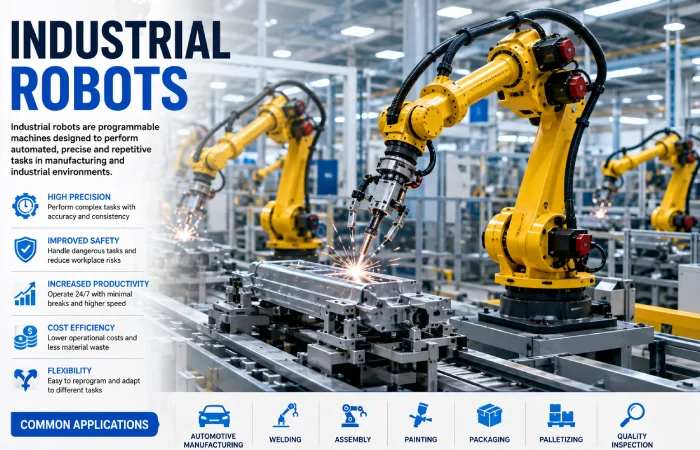
Industrial robots are some of the oldest types of robots, used primarily in manufacturing settings and equipped to carry out precise or repetitive movements or handle physical exertion.
A typical industrial robot may be a stationary robotic arm attached to a production line. It can repeatedly perform the same operation with consistent speed and precision.
Common industrial applications include:
- Welding
- Painting
- Assembly
- Packaging
- Material handling
- Quality inspection
- Palletizing
- Machine tending
For instance, an automotive plant can utilize robot arms, to weld components in a car. It can perform thousands of same movements with perfect positioning at each occasion.
Why Do Businesses Use Industrial Robots?
Industrial robots can provide companies with greater production efficiency and consistent quality. Additionally, they can handle duties that workers might find too dangerous. Tasks such as dealing with dangerous chemicals, extreme heat, heavy loads, and various other environmental hazards might be best suited for automated equipment rather than human workers.
| Benefit | Explanation |
| Productivity | Robots can operate for long periods |
| Precision | They can perform repetitive movements consistently |
| Safety | Robots can handle some dangerous tasks |
| Quality | Consistent processes can reduce variation |
| Efficiency | Automation can reduce certain repetitive workloads |
| Scalability | Automated processes can support high-volume production |
Despite that, industrial robots do not necessarily provide solution to all businesses. The investment cost in installation and programming along with maintenance, integration with overall work flow and need of employee’s training should take into consideration.
3. Scouting and Exploration Robots
There exist places too unsafe to man, too remote, too harsh and too unavailable for researchers and operators to send their equipment to explore. The robot’s function – so people and instruments would stay at safe distances
Such robots can vary from basic remote control machines to sophisticated automatic systems that learn from their environments.
Space Exploration Robots
Space agencies use robotics to investigate planetary bodies and phenomena, such as planets, moons, and asteroids.
The rover is a one of the best-known example. NASA’s Mars rover are used in many of the exploration mission. This expedition were planned in order to exploration of Mars surface with image taking capability, scientific data collection and investigation on its history.
This is where these robots can become incredibly useful as humans travel to a new planet has great complications and dangers.
Underwater Exploration
Robots can search the deep of the ocean, extreme pressure, dark place and the far distance that humans cannot reach.
An ROV is an submersible that can be manipulated by personnel on a surface ship or platform. An AUV is an submersible that can conduct operations largely without any remote human control.
Exploration Robot Applications
- Space exploration
- Deep-sea research
- Search and rescue
- Mining and geological research
- Disaster investigation
- Infrastructure inspection
- Environmental monitoring
Exploration robots are an essential example of robotics that humans can expand their capabilities in spaces that they physically can’t (or don’t want to) be themselves.
4. Consumer Robots
These consumer robots are built for use by everyone and in all contexts. However, in most cases, they interact with users but have not even the slightest hint of robotics attached to them.
A common illustration of such a technology is the robot vacuum. It relies on sensors and software for indoor navigation, for detecting and avoiding objects in its way, and performing the cleaning of rooms with a minimal human interaction.
Other consumer robots include:
- Robotic lawn mowers
- Window-cleaning robots
- Educational robots
- Entertainment robots
- Social robots
- Home security robots
These days consumer robotics and the Internet of Things, or IoT, go hand in hand. Your smart home, which is really just many connected robots that talk to each other, can have a smart robot, smartlights, cameras, and speakers and a smart thermostat.
Consumer Robots and AI
AI can also make consumer robots more intelligent, allowing their sensors and learning-algorithms to process information in order to know what’s going on around them and respond appropriately to situations in a dynamic fashion.
For example, the smart robotics camera, vacuum robot, for instance, might use machine learning for room-mapping and object-recognition with the aid of sensors and cameras.
Virtual assistants like Amazon Alexa and Google Assistant are not technically robots themselves as they don’t move to maneuver objects. Still, they show the potential of using an AI and natural language interface within smart homes and robots.
5. Medical Robots
Medical robotics is another highly topical domain in modern robotics. In medicine, robotic assistance is utilized in performing surgeries, rehabilitation, diagnose illnesses, patient care and so on.
A medical robot is not always a substitute to the human physician. A medical robot can serve as a complementary device that helps a medical expert in carrying out its tasks in a way that more controllability or precision is obtained.
Surgical Robots
With surgical robotics, the precision instruments and control offered could benefit some surgical operations.
The most notable example is the da Vinci Surgical System (developed by Intuitive) in which a surgeon controls the instruments from the control station.
“This robot never makes the decision itself – on how the surgery should actually go. The doctor still always has the final say; the device simply makes sure the doctor’s commands have executed precisely with the instrumentation,” the spokesman said.
Rehabilitation Robots
The other uses of robot can bring back lost of movement after injuries, surgery or disease processes.
Examples include:
- Robotic exoskeletons
- Robotic rehabilitation arms
- Gait-training systems
- Assistive robotic devices
These technologies can help therapists provide repetitive movements during rehabilitation.
Medical Robotics Applications
| Application | How robots can help |
| Surgery | Assist with controlled and precise instrument movement |
| Rehabilitation | Support repetitive physical exercises |
| Prosthetics | Provide movement assistance |
| Hospital logistics | Transport supplies and equipment |
| Disinfection | Automate certain cleaning processes |
| Patient assistance | Support selected daily activities |
The capabilities of medical robots hold a great deal of potential; however strict safety testing, qualified operators and regulatory adherence and cyber-security measures must be employed.
Other Important Types of Robots
The five above make some sense for a beginner’s understanding of the types, but robotics and the field goes much further in robotics.
Collaborative Robots or Cobots
Cobots (collaborative robots) are robots working with humans. Conventional industrial robots operate enclosed in a safety zone. Cobots are often provided with sensors and safety features that allow working close to a human.
Common uses include:
- Assembly
- Packaging
- Inspection
- Machine tending
- Material handling
Collaborative robots are beneficial for small to medium-sized businesses in that they can be used to automate certain tasks without a company needing to overhaul an entire plant layout.
Autonomous Mobile Robots
AMR – Autonomous Mobile Robot is a robot that can navigate their environment without any guidance required. They move using path planning without following specific, set routines.
AMRs can use cameras, sensors, maps, and software in their design to determine their location, how to reach their destination, and any obstacles in their path.
AMRs are increasingly used in:
- Warehouses
- Distribution centres
- Hospitals
- Manufacturing facilities
- Retail environments
For instance, AMRs are programmed for actions like picking up an object and routing themselves through your facility.
Automated Guided Vehicles
Autonomous Guided Vehicles (AGVs) represent the other major class of mobile robots. While numerous AMRs do not have dedicated guidance systems, traditional AGVs tend to rely on fixed paths or other specific guidance.
They are frequently used to move materials around factories and warehouses.
| Feature | AGV | AMR |
| Navigation | Often follows predefined routes | Dynamically navigates |
| Flexibility | Generally lower | Generally higher |
| Environment changes | May require route adjustments | Better suited to changing environments |
| Common use | Material transportation | Warehousing and flexible logistics |
The exact capabilities vary between systems, so the distinction is not always absolute.
Humanoid Robots
Humanoid robots, usually have bodies consisting of a head, torso, and limbs that are able to bend like human hands and feet. The intention is not only that the robots resembles humans but also that they should be able to function in human environments such as by walking stairs, opening doors, utilising existing workplaces and tools.
Potential applications include:
- Manufacturing
- Warehousing
- Research
- Education
- Customer service
- Assistance in difficult environments
Humanoid robotics is still in its developing stages and some key difficulties with regard to balance, energy, safely interacting with humans, reliable manipulation and high costs of building advanced machinery exist.
Drones
Drones are robotic flying systems that can run autonomously or at remote control. The use of drones has become a vital element in several fields since they assist in acquiring rapid data from hard-to-reach zones.
Major Drone Applications
| Industry | Example use |
| Agriculture | Crop monitoring |
| Construction | Site surveying |
| Energy | Infrastructure inspection |
| Media | Aerial photography |
| Emergency services | Search and assessment |
| Logistics | Experimental delivery systems |
| Environmental science | Wildlife and ecosystem monitoring |
Modern drones are equipped with a range of features including cameras, GPS, sensors, computer vision and AI enabling it to carry out more complex tasks.
Robots and Artificial Intelligence
Robotics and AI are related but they are not the same thing.
The concern of robotics revolves mainly around machines that can sense and move and manipulate the physical environment around them. AI is dealing with machines that can learn to solve problems involving prediction, perception, reasoning, decision-making, or prediction
When the two technologies are combined, robots can become more adaptable.
To illustrate, you may have traditional robotic programmed to perform the action of moving an object from point A to point B. The artificial intelligence robotic may also have the capacity to recognize many objects, be able to detect variations happening around it as well as make selection of the correct actions it should undertake.
Robotics Without AI vs AI-Enabled Robotics
| Traditional automation | AI-enabled robotics |
| Follows predefined instructions | Can adapt to changing situations |
| Usually performs specific tasks | Can handle more variable tasks |
| Limited perception | Can use computer vision and other AI systems |
| Predictable environment preferred | Can operate in more complex environments |
| Easier to understand and control | Potentially more flexible but more complex |
AI does not make every robot autonomous. Many robots still require humans for supervision, planning, maintenance, or decision-making.
Emerging Robotics Trends
According to the International Federation of Robotics (IFR), robotics continues to expand across manufacturing and other industries as businesses increasingly adopt automation and intelligent robotic systems. These developments are helping organizations improve productivity, flexibility, safety, and efficiency.
1. Greater Human-Robot Collaboration
The future of robotics won’t be about taking out each and every single human being. In many scenarios, robots are an asset when it helps man.
Tasks involving judgment, creativity, social interpretation, and managing surprises are usually the ones where humans excel and robots are inferior. Tasks such as repetitive, accuracy, heavy, and risky are typically where humans and robots shine.
This combination can create more effective workplaces.
2. Smarter Autonomous Robots
With better sensors, computer vision, AIs and better navigation, robot understanding of what is going on can improve over time. Robots are still being programmed, but some will also start responding and moving adaptably within the surrounding environment.
3. Robotics in Logistics
Supply chain modernity and e-commerce has risen the call for ever faster and more efficient logistics processes.
Robots can support:
- Picking
- Sorting
- Transportation
- Packing
- Inventory management
- Warehouse inspection
Typically, the point is not necessarily to replace humans in order to put them out of work, but instead to automate the repetitive physical activities of the job and freeing human workers for their judgmental tasks.
4. Robotics in Agriculture
Labor shortages, resource efficiency, crop monitoring, the need to improve productivity are all challenges for agriculture.
Robots and drones are useful to implement precision agriculture. Collecting data on crops and soil can be provided by those devices.
Future agricultural robots may perform tasks such as:
- Weed detection
- Crop monitoring
- Selective harvesting
- Automated spraying
- Soil analysis
- Fruit picking
5. Soft Robotics
Traditional robots commonly feature hard rigid structures. Soft robotics, on the other hand, works based on flexible mechanisms and materials-emulating biological features and movement techniques.
The use of soft robots may be appropriate where machines must delicately manipulate objects or interact with people intimately. Such applications include: food handling; medical use; wearable devices and; research.
6. Robotic Cybersecurity
As robots gain network and cloud connectivity the issue of robot cybersecurity grows more important. Any robot that gains network connectivity potentially becomes a target and thus cybersecurity has to be considered throughout the robots life.
Important areas include:
- Secure communication
- Authentication
- Software updates
- Access control
- Data protection
- Network monitoring
The strong security demanded of a robot able to physically affect its surrounding environment is evident in the reality that the consequences of a cyber-attack on such a robot could be extremely tangible.
7. Sustainable Robotics
Sustainability in Robotics becoming more significant nowadays; robots can lower waste, improve efficiency in use, and observe different environments to facilitate some process.
Simultaneously, robots need to be built; they need materials, electronics, batteries, power and they need maintenance and eventual recycling. Sustainability robotics has to be considered across the entire cycle.
Advantages of Robots
Robots can deliver very considerable advantages when conceived and implemented correctly.
Increased Productivity
Robotic systems will also repeat all tasks with no hesitation, which will help production capacity rise up.
Improved Precision
As robot movements are highly repetitive, robots may be useful for consistency in tasks:
Better Workplace Safety
Robots can help to take on some of the dangerous tasks where exposure to harmful conditions can be a factor.
Reduced Repetitive Work
Automation can take care of physically demanding activities to allow the human employee time to perform those activities that involve problem-solving or judging situations.
Operation in Difficult Environments
Robots will provide advantages where humans shouldn’t go, in places such as ocean depths, industrial facilities, and at sites of natural disasters.
Challenges and Limitations of Robotics
Despite their advantages, robots are not a perfect solution.
| Challenge | Why it matters |
| High initial cost | Robots and integration systems can be expensive |
| Maintenance | Mechanical and software systems require ongoing support |
| Skills gap | Businesses need trained employees |
| Cybersecurity | Connected robots can create new security risks |
| Safety | Robots must operate safely around people |
| Limited flexibility | Some systems struggle with unexpected situations |
| Job transformation | Automation can change the types of skills employers need |
| Energy use | Robots require electricity and sometimes battery systems |
The right approach is therefore not simply “use more robots.” Businesses should first identify the problem they want to solve and then determine whether robotics provides a practical solution.
How to Choose the Right Robot
Organizations considering robotics should evaluate several factors before investing.
Step 1: Identify the Task
Be able to identify the actual problem. Is your job repetitive, dangerous, demanding physically or simply too predictable?
Step 2: Examine the Environment
Think about the space, light, temperature, floor, machines used and environment.
Step 3: Determine the Required Level of Autonomy
Some tasks only require simple automation. Others require robots to navigate, identify objects, or make decisions.
Step 4: Calculate the Total Cost
The purchase price is only one part of the investment. Businesses should also consider:
- Installation
- Integration
- Programming
- Training
- Maintenance
- Software
- Energy
- Upgrades
Step 5: Consider Safety and Security
Robots operating around people must have appropriate safety measures. Connected robots should also have strong cybersecurity protections.
Step 6: Measure Results
When the robot is implemented, businesses need to monitor if the robot is indeed improving, for example, its productivity, its quality, its safety, its costs efficiency.
The Future of Robotics
The future and advancement of robotics will probably be dictated through integration with other technological areas such as robotics, AI, cloud and edge computing, computer vision, sensors, Internet of Things.
Robots are also likely to become more adaptable. Instead of designing a separate machine for every individual task, developers are working toward systems that can learn to perform multiple tasks and operate in changing environments.
Humanoid robots, autonomous mobile robots, cobots, drones, medical robots, and agricultural robots are all examples of areas receiving significant attention.
However, innovation will not stem simply from making robots smarter. Robots need to get better at working in a human world as well: safer, more dependable, cheaper, greener, secure, and easy to use. The biggest future triumphs might actually involve people working together with robots, instead of being directly replaced.
Conclusion
Robots are no longer just metal robots on a factory floor. Robotics now range from autonomous robotic arm and vehicles to drones, medical robot systems, warehouse robot machines, underwater vehicles, exploration rovers, consumer machines, and the more recent human robotic device.
It’s easy to understand the main categories of robot by looking at how robots move, function, operate, or act autonomously. For instance, industrial robots deal with making products, exploration robots permit humans to look around the places hard to access. Consumer robots make daily tasks easy whereas the medical robots help healthcare worker whereas the mobile robot assist businesses in logistics operations.