An unrestricted AI image editor software based on an unrestricted AI that undertakes any image editing task — inpainting, style transfer, retouching, enhancement, and generation — with no content classifiers, no safety filters, and no restrictions. It is the editing element of an all-encompassing unrestricted AI system that also features image creation, video creation, and face swapping. All functions can be done without the content restrictions imposed by Adobe, Canva, and Midjourney.
An unrestricted AI image editor means you have more creative flexibility than you would with a traditional AI image editor. If you find the right solution, then you can, in theory, do anything to an image, including retouch, alter, apply a new style, upgrade, zoom, or twist it without the same restrictions.
This Article is a Part of AI Tools
Table of Contents
What Is an Unrestricted AI Image Editor?
An unrestricted AI image is an editing tool powered by the AI that gives you the ability to modify a current image by using automated editing models.
Rather than iterating with layers, masks, brushes and a myriad of complex sliders and adjustment panels, a human can simply describe the type of edit they’re after, and the AI will go analyze the image to do the work.
The typical features are AI inpainting, object removal, image recovery, style transfer, retouching, background modification, image rotation and expansion.
“Unrestricted” may mean different things on different services. Typically, it suggests more leeway with creativity and fewer restrictions related to content than there is that every service is entirely rule-free. Remember to read the terms of service, privacy policy, and acceptable-use policies before uploading commercial or private content.
How Does an Unrestricted AI Image Editor Work?
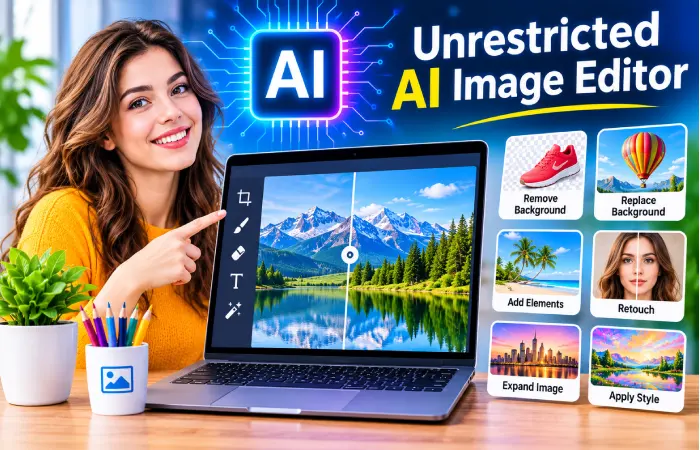
It is a rather simple principle – you upload an image, tell what you want to change, and give the AI model a couple of seconds to get the job done.
Higher systems are based on computer vision and generative AI in order to capture the connection between the object, background, colour, lights, textures, and composition.
For instance, you may instruct the editor to erase a stray object on an image. The artificial intelligence recognizes the chosen region and produces new pixels designed to blend in with the adjacent area.
You can also do something similar for generative fill. Rather than deleting the part of the image, the AI can generate visual information that you did not originally have in the photo.
| AI Editing Feature | What It Can Do | Common Use |
| AI Inpainting | Modify or replace selected areas | Creative image changes |
| Object Removal | Remove unwanted elements | Photography and cleanup |
| Style Transfer | Apply a different visual style | Digital art |
| AI Upscaling | Improve image resolution | Web and print graphics |
| Retouching | Enhance selected image details | Portrait photography |
| Background Editing | Replace or modify backgrounds | Product and social media images |
Key Features of an Unrestricted AI Image Editor
One of the most popular features is AI inpainting. Users can choose a region of the image and type in a prompt to replace it, fix it, or completely change the design.
Another crucial ability is style transfer. It might be possible to alter a picture into a specific form of art while still preserving the core elements of the original photo.
AI enhancement Useful when you have an image and it doesn’t contain enough detail. Large images, where the upscaler model and source image mean the new image can appear sharp with a large file suitable for a website, a presentation, social media, or other use.
Certain higher-end platforms also integrate editing features along with image creation and video tools. This means you can have a process flow where you can generate an image, edit it, enhance it, and eventually translate it into animated or video form without juggling between apps.
Unrestricted AI Image Editor vs Traditional Editors
Standard photo-editing programs are still very handy, especially for professional designers who are used to the expensive and detailed editing tools. However, as an AI editor can ease up quite a big part of the work.
| Factor | AI Image Editor | Traditional Image Editor |
| Ease of use | Usually beginner-friendly | Requires more training |
| Editing speed | Fast for many AI tasks | Depends on manual workflow |
| Prompt-based editing | Common | Limited or unavailable |
| Manual control | Varies by platform | Usually extensive |
| Generative editing | Often integrated | May require additional tools |
| Complex professional work | Increasingly capable | Highly established |
Rather than completely replacing traditional software, AI editing can complement it. A designer might use AI to generate or modify an image and then use conventional editing tools for precise finishing.
Who Can Benefit From an Unrestricted AI Image Editor?
Here’s how digital artists can take advantage of them. Allows for quick experimentation Artists may use these spaces to explore unconventional arrangements, styles or visual ideas. With the capability to create a few variations of an idea, it offers more flexibility with creativity.
Blog images, social media images, thumbnails, promotional photos, and other digital files. Faster editing can come in handy if a creator needs to generate multiple variations of the same image.
Photographers can also benefit from AI-assisted retouching, background modification, object removal, and image enhancement. Instead of spending significant time on repetitive corrections, they can use AI for the first stage of the workflow and perform detailed adjustments afterward.
Businesses may use AI image editing for product presentations, advertising concepts, website graphics, and marketing materials. However, commercial users should verify licensing and usage rights before publishing AI-modified content.
| User Type | Potential Application |
| Digital Artists | Creative transformations and style experiments |
| Bloggers | Featured images and article graphics |
| Social Media Creators | Posts, thumbnails and promotional visuals |
| Photographers | Retouching and object removal |
| E-commerce Businesses | Product backgrounds and presentations |
| Marketing Teams | Campaign concepts and visual variations |
Privacy and Image Security Matter
There are more things to worry about when choosing an AI image editor that include the creative elements. Privacy is something that we need to look into as well.
If you post any material or information when using an AI online image generator, this may include personal data, commercial business data, personal photographs or proprietary designs or product design models. Be sure to familiarize yourself with the processing, storing and deleting of upload files.
Check for straightforward details regarding encryption, retention of data, auto-deletion, human review and if images submitted will be used for training models.
Be sure to verify you have all legal rights to any images you upload. Please remember: AI editing cannot transfer copyright, privacy, or consent responsibilities.
How to Get Better Results
The quality of an AI edit often depends on how clearly the desired change is described. Instead of using a vague instruction such as “make this image better,” provide specific details.
For example, a prompt could say:
“Set the background to a modern office background, keep the main subject unaltered, retain the natural lighting and add realistic shadows.”
Furthermore, it can be useful to tell the AI what to keep. You can have it retain the subject, the composition, the colours, the lighting or other details.
Take a close look. The change may contain strange textures, inconsistent details, deformed objects, or unnatural shadows.
Conclusion
Make an AI Edit and Improve Any Image Using unrestricted AI image editor Inpainting, removing objects, style transfer, retouching, upscaling, background edits, and more changes can help you generate the perfect image. The biggest advantage: Creative freedom. Make high-quality edits effortlessly, easy tools for the inexperienced, harness AI to help automate the more tedious aspects of your workflow.