
Last Updated: September 1, 2026
AI (Artificial Intelligence) is revolutionizing the world of people: their living, working, communicating and solving problems. Examples range from virtual assistants and recommendation systems in our daily life to complex health care tools and self-driving machines. But then again, will Artificial Intelligence make a positive future?
Ultimately, one of the key values which AI can generate is enabling better decision making by humans, automating tasks which are tedium and taking up time, making of improvements on the common services which we use, and also to solve some of the hardest problems the world has ever faced. Once you’re clear on what Artificial Intelligence is and how it works, these opportunities also become much more obvious.
This Article Belongs to AI Tools
Table of Contents
How Will Artificial Intelligence Improve the Future?
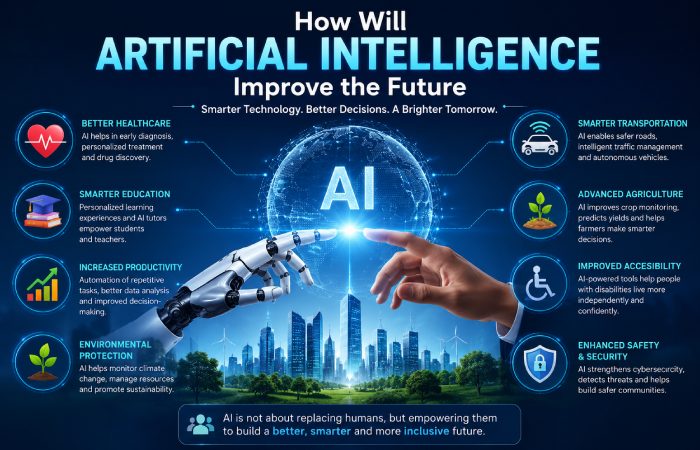
Every significant industry will likely be affected by the arrival of artificial intelligence (AI). Instead of replacing people for the sake of eliminating what people already do, in its highest form, it will most likely exist to assist humans, offering quicker insights, more precise outcomes, and automation that is smart.
| Area | How AI Can Improve the Future |
| Healthcare | Earlier diagnosis, personalized treatment, and faster drug discovery |
| Education | Personalized learning and intelligent tutoring |
| Business | Automation, better forecasting, and improved customer service |
| Transportation | Safer navigation and smarter traffic management |
| Environment | Climate monitoring and efficient resource management |
| Agriculture | Better crop monitoring and precision farming |
| Accessibility | Tools that assist people with disabilities |
1. Better Healthcare and Medical Research
One of the most compelling areas for applying AI is in healthcare. AI applications can sift through medical information to assist professionals in finding patterns that are hard to identify.
In the future AI may enable faster diagnosis of disease, support in the formulation of individualized therapy, and enable new drug discoveries. Patient needs could be forecasted, or resources managed within hospitals by use of AI driven systems.
Importantly, rather than replace medical staff, AI is likely to work in collaboration with them, leaving room for human expertise, emotion and ethics.
2. More Personalized Education
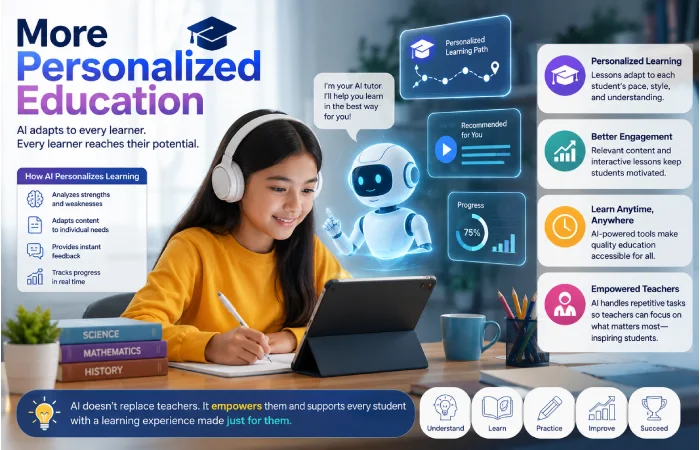
AI could make education more widely available and tailored to individual learning preferences. Smart learning systems, by observing the student’s interaction with an educational resource can deliver a customised learning program.
For example, an AI tutor may provide extra explanations where a student is having difficulties or more difficult exercises where the student learns at a rapid pace.
This may enable the teacher time to assist other pupils, without being constantly encumbered by mundane administrative tasks. AI can make learning more personalized by adapting educational content to individual student needs. UNESCO’s Artificial Intelligence resources examines AI’s role in education and society.
3. Increased Productivity at Work
AI can be used for any repetitive task, including document processing, data analysis, scheduling and even handling some customer queries.
This doesn’t mean human employees are irrelevant; however, jobs could adapt by using AI to take over repetitive tasks, and employees focus on tasks involving imagination and creativity, strategy, communication and challenging problem-solving.
Businesses that ethically embrace AI can be more efficient but and employees may need to focus on higher-level job functions.
4. Smarter Transportation
It is predicted that transportation efficiency will be further enhanced due to AI. Intelligent traffic control can monitor the road status, vehicle movements, congestion levels, etc.
AI-powered vehicle applications could increase vehicle safety by providing vehicles with awareness of their surroundings & in responding to evolving conditions. Public transportation services can also implement AI in the vehicle’s routine, planning & scheduling of activities.
The transportation system, with AI integration, would become more efficient as well as sustainable.
5. Helping Protect the Environment
With its capacity for processing vast amounts of climate data received from satellites, sensors, weather systems and more, AI could assist researchers in keeping an eye on trends, tracking changes and managing natural resources.
AI might be able to aid in helping commercial and public sectors reduce energy consumption while identifying areas for investment in innovative renewable systems and technologies. Businesses are able to use AI for forest monitoring, as are water management authorities.
The development and deployment of AI must be carefully handled to avoid its high energy requirements outweighing its benefits:
6. Improving Accessibility
Another benefit of AI is that is makes technology more accessible. With speech recognition, real time translators, image descriptions and smart assistant, technology can provide a new interaction through which people access digital services.
Whether it is individuals with sight, hearing, mobility, and/or communicative difficulties, AI is in a position to provide improved mobility and accessibility to education, jobs, and general life assistance.
Challenges of an AI-Powered Future
But of course the development of AI also brings new challenges to our existing society. What about personal data, cybersecurity, fake news, algorithmic bias, loss of income and the use of personal data?
For a broader look at the potential benefits and challenges associated with AI, see profits and risks of Artificial Intelligence.
| Opportunity | Potential Challenge |
| Automation | Workforce disruption |
| Personalized services | Data privacy |
| AI decision support | Algorithmic bias |
| Generative AI | Misinformation |
| Connected systems | Cybersecurity risks |
It will be up to governments, technology companies, researchers and local communities to develop appropriate standards and safeguards. We must retain human control and judgment in applications where an AI could have a disproportionate impact on an individual’s well-being.
The Future of Artificial Intelligence
The way AI gets smarter, along with how it responsibly progresses and is applied in the future, will distinguish the path forward for this emerging technology. People may be better prepared to sift through information and understand it, automate common tasks to increase capacity, explore innovations to common problems and expand access to necessities and important resources.
Clearly, then, the most desirable future isn’t one in which machines replace people. It’s a future in which humans and computers operate collaboratively, melding machine logic with human insight, decision-making, empathy, and accountability.
Conclusion
Artificial Intelligence can bring forth changes to improve society in many key areas: healthcare, education, business, transport, the environment and access, due to its capacity to think fast and make decisions to solve problems.
But attaining these benefits will necessitate responsible innovation. As we continue to navigate the challenges related to privacy, accountability, fairness and security, employment and impact on society, AI will serve as a profoundly positive and transformative innovation to a more productive, available and sustainable society.
When considering the growing role of AI in protecting sensitive information, you can also learn more about using Artificial Intelligence to help keep your financial data safe.