
Last Updated: September 1, 2026
Table of Contents
Introduction
Machine learning (ML) is now one of the hottest emerging trends shaping the way we use and navigate the digital sphere. The machine is becoming intelligent enough to predict and suggest content you’d like to watch from video streaming applications, prevent fraud in your bank account and Credit Card transaction, diagnosing medical issues, helping a self-driving car to navigate, virtual assistants as a helper and powered by the concept of generative Artificial Intelligence (AI) into various consumer products and business process.
In its simplest form, machine learning is the capability given to a machine that allows machines to find patterns in data and use them in a manner that the computer then finds and uses to solve problems with a prediction, decision-making, or as a basis for formulating an action. Rather than being programmed for a solution to a given problem explicitly, an ML solution uses examples and relevant data to solve it.
This article gives a detailed guide to Machine Learning beginning from fundamental concepts and definitions to the different ML techniques, advantages, drawbacks, applications, and the future of ML technology.
This Article Belongs to Machine Learning
What is Machine Learning?
Machine learning is an part of artificial intelligence where computer systems can identify patterns within data sets, and then utilise these patterns to carry out a job or make a prediction.
Traditional software generally follows a straightforward process:
Rules + Data → Output
A programmer defines the rules, the computer processes the input, and the system produces an output.
Machine learning changes this approach:
Data + Expected Outcomes → Model
The machine learning system considers each of the examples and produces a mathematical function that can make an educated guess when provided with new, unseen data. Let’s assume we wanted to create a machine learning model for filtering spam in emails. We don’t need to try and specify the thousands of rules needed to describe every type of spam message.
Instead, we can use our machine learning model to learn what makes a spam message a spam message and what makes a non-spam message a legitimate message.
Unfortunately, poor quality data, too little data or a lack of representative data, are all likely to result in a poor quality machine learning system.
How Does Machine Learning Work?
Machine learning solutions are often quite intricate but let’s just break down workflow with the help of basic steps below.
1. Data Collection
First step is to collect suitable data. Based on the type of problem, this could be obtained from databases, websites, sensors, transaction logs, applications, images, videos, documents or through interaction with users.
For example, a company developing a house-price prediction model might collect:
- Property size
- Number of bedrooms
- Location
- Age of the property
- Amenities
- Historical sale prices
2. Data Preparation
The raw data is not yet in a form that can be used. It will very often contain records with values missing from fields, duplicated records, inconsistently defined data fields or irrelevant items.
Data preparation can involve:
- Removing duplicates
- Handling missing values
- Correcting errors
- Normalizing numerical values
- Encoding categorical information
- Removing irrelevant variables
- Detecting unusual observations
This stage generally takes up a significant part of a machine learning project.
3. Feature Engineering
A model utilizes characteristics to make a prediction.
For a customer churn prediction system, potential features might include:
- Customer age
- Subscription duration
- Number of purchases
- Customer-support interactions
- Average monthly spending
- Recent account activity
Feature engineering the process of selecting, transforming or creating predictor variables that allow a learning algorithm to model and understand the underlying trends of an underlying mechanism.
4. Model Selection
Each task demands different types of algorithms. For instance, a developer could opt for a linear regression, decision tree, neural networks, SVM, clustering, etc depending on the type of the task and information provided.
5. Training
When the algorithm learns, it “studies” the data and adjusts some internally generated knobs in order to decrease the overall error or to discover some patterns. In the supervised approach, the training system is fed with labeled samples, which are samples containing data and the correct results.
For instance:
Input: Customer information
Expected output: Customer will churn
The model learns the relationship between the input variables and the target outcome.
6. Evaluation
When training is completed, and the data used during it have not utilized in the learning period, the model needs for tested based on that. It would be useful to check if the model has learnt some patterns instead of that learning to test how well this information is acquired.
Common evaluation metrics include:
- Accuracy
- Precision
- Recall
- F1-score
- Mean absolute error
- Mean squared error
- Area under the ROC curve
The appropriate metric depends on the problem.
7. Deployment
After the model has been built to the desired level of performance, it is deployed in a business process or application.
A model designed to detect fraud can for example analyze a financial transaction, and provide a risk score for that transaction.
8. Monitoring and Updating
The end of model deployment isn’t necessarily the end of ML. Real world data continues to change over time. Customer habits, market conditions, ways to circumvent fraud detection, language use etc, all can change, potentially leading to model drift, which is the gradual degradation of a models performance. It is for this reason that organizations have to be continually updating and redeploying or retraining any models they have in production.
Types of Machine Learning
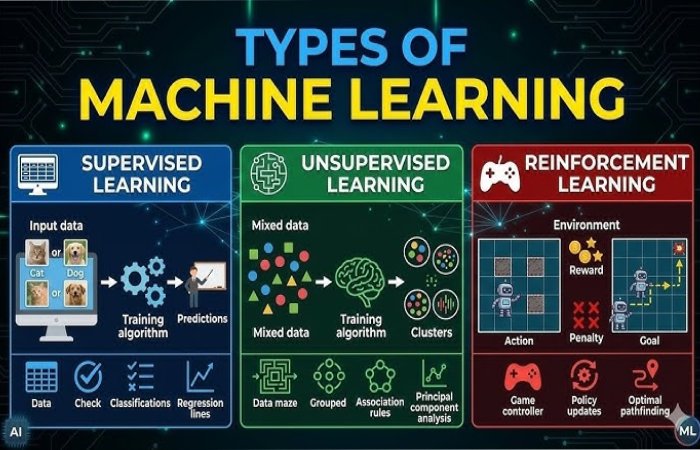
The branch of Machine Learning is categorized into Four Broad categories- supervised learning, unsupervised learning, semi-supervised learning and reinforcement learning.
| Type | Main Idea | Typical Uses |
| Supervised Learning | Learns from labelled examples | Classification, prediction, forecasting |
| Unsupervised Learning | Finds patterns in unlabeled data | Clustering, anomaly detection |
| Semi-Supervised Learning | Combines labelled and unlabeled data | Image and document classification |
| Reinforcement Learning | Learns through actions and rewards | Robotics, games, control systems |
1. Supervised Learning
Supervised machine learning algorithms use vast amounts of labelled training data. Input features and an expected output (target), are present for each training set example. Supervised learners generate a predictive model based on data unseen during training, creating a map between inputs and outputs.
Classification
Classification predicts a category.
Examples include:
- Spam or not spam
- Fraudulent or legitimate
- Disease present or absent
- Positive or negative customer sentiment
Regression
Regression predicts a numerical value.
Examples include:
- Predicting house prices
- Forecasting sales
- Estimating delivery time
- Predicting energy consumption
The most common supervised learning algorithms are linear regression, logistic regression, decision trees, random forest, support vector machines, and neural networks.
2. Unsupervised Learning
Working on data that has no pre-defined labels is unsupervised learning. The purpose of using it is to find out concealed patterns, structures, or relation in data.
Clustering
Clustering groups similar observations together.
For example, an e-commerce company could analyze customer behavior and identify groups such as:
- Frequent high-value customers
- Occasional buyers
- Discount-focused shoppers
- Customers who are becoming inactive
Popular methods of clustering include: K-means clustering, DBSCAN and Hierarchical clustering.
Dimensionality Reduction
Data has potentially hundreds or thousands of variables. Reducing dimensions of the data using fewer dimension, without important information of the data is called as dimensionality reduction. Techniques include PCA and many neural network approaches.
3. Semi-Supervised Learning
Semi supervised learning uses a tiny proportion of labeled data along with a substantially bigger proportion of unlabeled data. This could be handy where getting marks is difficult or requires qualified human experts. Labelling tens or hundreds of thousands of healthcare pictures, for example, requires professional individuals. A program can make use of a much lesser set of expert marked photos alongside a substantially larger uncontrolled dataset.
4. Reinforcement Learning
Reinforcement learning is interactive in nature. The agent takes actions inside a task environment, resulting in punishment or the reward depending on the outcome that it achieves because of the actions. From that action over time, it acquires a strategy, whose aim is to maximize the accumulative reward.
Reinforcement learning has been applied to areas such as:
- Robotics
- Game-playing systems
- Resource optimization
- Autonomous control
- Recommendation strategies
- Industrial automation
Machine Learning vs. Artificial Intelligence vs. Deep Learning
These terms may be thrown around interchangeably but they actually have entirely different definitions.
Artificial Intelligence (AI) is the largest concept. It refers to systems designed to perform tasks associated with intelligent behavior.
Machine Learning is one of the significant streams of AI and in ML systems study from data.
Deep Learning refers to a specific area of machine learning, employing neural networks with multiple layers.
The relationship can be represented as:
Artificial Intelligence → Machine Learning → Deep Learning
The application of deep learning is not limited to complex problems with images, speech, and natural language; it is now extended to other dimensions of data.
What Is Deep Learning?
Deep learning applies models such as neural networks composed of many processing layers of the units composing them. Through the depth, these networks can learn data representations which get more and more sophisticated at each level.
Major deep-learning architectures include:
- Convolutional Neural Networks (CNNs)
- Recurrent Neural Networks (RNNs)
- Long Short-Term Memory networks (LSTMs)
- Autoencoders
- Transformer architectures
Transformers are now more critical in the fields of contemporary natural language processing and generative artificial intelligence.
Common Machine Learning Algorithms
Different algorithms are designed for different problems.
| Algorithm | Category | Typical Application |
| Linear Regression | Supervised | Numerical prediction |
| Logistic Regression | Supervised | Binary classification |
| Decision Tree | Supervised | Classification and regression |
| Random Forest | Supervised | Classification and prediction |
| Support Vector Machine | Supervised | Classification |
| K-Means | Unsupervised | Customer segmentation |
| DBSCAN | Unsupervised | Clustering and anomaly detection |
| PCA | Unsupervised | Dimensionality reduction |
| Neural Networks | Supervised/Unsupervised | Complex prediction tasks |
| Reinforcement Learning Algorithms | Reinforcement | Sequential decision-making |
Applications of Machine Learning
Machine learning is a useful technology that now spans multiple industries.
Healthcare
Machine learning can improve analysis of medical images, risk prediction, patient monitoring, drug discovery, and automate administrative tasks. For example, computer vision models can look at medical images and find patterns which a medical professional should take further look.
Machine learning algorithms can also identify relationships within large data of biological information. But in health there needs to be highly accurate validation, security & privacy, and need to be able to be explained, as well as have human feedback.
Finance and Banking
Financial institutions use machine learning for:
- Fraud detection
- Credit-risk assessment
- Algorithmic trading
- Customer segmentation
- Anti-money-laundering analysis
- Financial forecasting
It’s a good example of how fraud detection is performed as well. Given certain features of transactions, a model can find anomalous behavior and flag them as possible fraud.
E-Commerce
Online retailers use ML to personalize digital experiences.
Applications include:
- Product recommendations
- Search ranking
- Demand forecasting
- Customer segmentation
- Dynamic inventory planning
- Fraud prevention
Previous purchase, viewing pattern, product similarities and many other signals can be used by a recommendation system to derive an estimate about which products may be of interest to a customer.
Manufacturing
Machine Learning for Improvement in Manufacturing. Other uses for machine learning, besides predictive maintenance, include increasing productivity through: Quality control; demand forecasting; optimization of the production line. The examples are countless. For instance, a factory may have sensors on their machines that will record all kinds of data.
The machine learning algorithm is trained with this data to identify if a piece of equipment needs repairs in advance by spotting out typical patterns for failure. This enables to lower the chances for any costly interruptions.
Transportation
ML plays a crucial part of route optimization, traffic forecasting, logistics, fleet management, and autonomous vehicle research. It can estimate transit times and optimize delivery routes by the use of historical and real time information
Agriculture
ML can analyze satellite imagery, weather information, soil measurements, and crop data.
Potential applications include:
- Crop disease detection
- Yield prediction
- Irrigation optimization
- Weed identification
- Agricultural monitoring
Cybersecurity
Machine learning can be used to identify suspicious activities that are happening over the network as well as to identify malicious activity, malicious login activity, potential security threats, and abnormal network activity. Adaptive models may be useful because of how malware and cyber attacks constantly change to be something new so that traditional rule-based systems will not detect.
Advantages of Machine Learning
Machine learning offers several important benefits.
Automation
ML allows for the automation of common analytical jobs and requires less manual intervention.
Improved Predictions
ML models are quite efficient in discovering complex relationships, which can’t even be discovered through manual exploration, especially if you have a high-quality data set to work with.
Personalization
Recommender and personalization systems tailor experiences to users.
Scalability
When a model is put into practice it can take in much more data than would be practical for a human, and do it much more quickly than a manual approach.
Continuous Improvement
Most ML programs can also be retrained with new information when the patterns change.
Limitations and Challenges
Responsible machine learning requires attention to reliability, transparency, privacy, security, and potential bias throughout the AI lifecycle. NIST’s Artificial Intelligence resources provide authoritative guidance on trustworthy and risk-aware AI development.
Still machine learning doesn’t solve all the problems.
Data Quality
Poor model outputs result from poor inputs. Results can be impacted negatively by data that is missing, inaccurate, biased, or inconsistent.
Bias
If the training data is inherently discriminatory (historically biased or structurally biased), this will likely result in the training of a biased model.
Interpretability
Some of the modern algorithms have poor readability. It is often confusing what to do when one has a prediction of the given models. They are very crucial especially in high value, and sensitive use case.
Overfitting
Overfitting is when a model is excessively sensitive to the training data, it memorizes that particular data but is ineffective with new data. The model must capture a general, non-exemplar pattern.
Privacy
ML systems typically handle large volumes of personal or sensitive data. It is imperative to ensure appropriate governance and security controls are used
Machine Learning in Business
Machine learning is increasingly adopted across industries to optimize decisions and operational functions
A typical business ML workflow can look like this:
Business Problem → Data → Model → Evaluation → Deployment → Monitoring
For example, a subscription company may want to reduce customer churn.
The organization could:
- Collect historical customer data.
- Identify customers who previously canceled.
- Create relevant features.
- Train a classification model.
- Evaluate its predictions.
- Identify customers with elevated churn probability.
- Provide targeted retention offers.
- Monitor whether the intervention improves retention.
A key takeaway is that ML should solve a real business problem not just be implemented to keep up with technological trends.
Machine Learning and Big Data
So the evolution of machine learning is inextricably linked to the evolution of data.
Organizations now generate enormous quantities of information through:
- Websites
- Mobile applications
- IoT devices
- Financial transactions
- Social platforms
- Enterprise systems
- Sensors
- Digital communications
Huge amounts of data are great to train on, but it’s not just about size alone to get to good results. You need data to be accurate, representative, relevant and labelled well. Also have to make sure that it can be legally sourced and ethically used.
The Machine Learning Development Lifecycle
A successful ML project typically involves an iterative lifecycle.
| Stage | Key Question |
| Problem Definition | What are we trying to predict or optimize? |
| Data Collection | Do we have suitable data? |
| Data Preparation | Is the data clean and usable? |
| Feature Engineering | Which information is useful to the model? |
| Model Training | Which algorithm works best? |
| Evaluation | Does the model generalize? |
| Deployment | Can it operate reliably in production? |
| Monitoring | Is performance changing over time? |
| Retraining | Does the model need updated data? |
Machine learning isn’t just as easy as picking an algorithm. A great part of the process is defining the problem, getting the data ready, analyzing the results, or maintaining it.
The Role of Human Expertise
While machine learning has been benefiting significantly from automation, there is no substitute for human involvement. In data science, machine learning, domain experts, software engineers, security engineers and the business domain specialists may contribute in various forms of knowledge.
Human involvement is particularly important when:
- Data requires expert interpretation
- Decisions have significant consequences
- Model outputs need explanation
- Bias must be evaluated
- Privacy and security risks must be managed
- Business objectives need to be translated into technical requirements
Many systems are most successful by supplementing the abilities of computers with those of humans rather than trying to remove humans from the process entirely.
Machine Learning and Generative AI
Generative AI represents an important development within modern machine learning.
Generative models can create new content such as:
- Text
- Images
- Audio
- Video
- Software code
Awareness of Machine Learning has been raised due to public interaction with machine learning through the interface of natural-language chat of generative AI. Research into techniques such as calibration for improving few-shot performance of language models also demonstrates how machine learning methods can be used to improve the reliability and performance of language models. BUT there’s one caveat too; generative models also include “hallucinations,” the problem of misinformation and intellectual property; data privacy and security; “appropriate human-in-the-loop “ scrutiny” etc.
Future of Machine Learning
The field of machine learning’s future probably lies on continued integration with daily applications, devices, operations, and scientific investigation. Several areas are particularly significant.
Edge Machine Learning
Rather than transmitting all the data back to a central data center, more and more models will run natively on the devices, which could be a smartphone, camera, car, industrial robot etc.
This can reduce latency and potentially improve privacy.
Explainable AI
As ML systems become ever more pervasive in impact, organizations will begin seeking ways to get closer to models and explain what is happening.
Smaller and More Efficient Models
It is probable that the model delivery, coupled with less intensive computationally, would still be the area for more research as well as engineering work.
Autonomous Systems
Continued Growth Machine learning will extend its impact to Robotics, Transportation, Industrial Systems and Other applications that need automated decision making.
How to Learn Machine Learning
A beginner who enters into the world of machines Learning can find it confusing as ML has the collection of programing, Math, Stats, Data analysis and domain knowledge.
A practical learning path is:
Python → Mathematics & Statistics → Data Analysis → Classical ML → Deep Learning → Projects → Deployment
Start with basic programming concepts and data manipulation. Then learn foundational statistics and probability before moving into supervised and unsupervised learning. Those interested in turning these skills into professional opportunities can also explore career paths in machine learning.
Practical projects are especially valuable. Examples include:
- Spam detection
- House-price prediction
- Customer segmentation
- Sentiment analysis
- Image classification
- Sales forecasting
- Recommendation systems
Building projects helps connect theoretical concepts with real-world implementation.
Conclusion
Machine learning is arguably one of the most significant modern technological advancements. Machine learning has allowed us to recognize patterns in data and learn them through the utilization of computational programs and data, which in return has reshaped industries such as; health care, finances, retail & e-commerce, manufacturing & production, transport & travel, agricultural farming and livestock management, cyber security and further expanding artificial intelligence fields.
Although advanced and complex, it is important to note that machine learning’s capabilities do not solely hinge upon complex algorithms; also needed are the inputs of reliable data, defined problem solving, diligent testing, responsible deployment, security protocols, private data regulation and human management.
Finally, this article aims to show that machine learning not only relates to programs learning to generate predictions. Rather it consists of generating valuable data intelligence into useful decisions. Thus by utilizing the computational power to increase reliability, transparency, humanity and intelligence all at once.