
Last Updated: September 1, 2026
AI has rapidly moved from a futuristic ideal to a current business and daily life tool, and the transformation that it has already made to businesses through automated customer service, analysis and content generation, and its application to fields such as medical research, is considerable. Despite the considerable benefits offered to businesses through efficiency and profit generation, it is also necessary to acknowledge that a range of financial, ethical, security and operational risks have been created.
Understanding the Profits & Risks of Artificial Intelligence is essential for businesses and individuals to make the most of AI’s benefits while managing its financial, ethical, security, and operational challenges.
This Article Belongs to AI Tools
Table of Contents
What is Artificial Intelligence?
Artificial Intelligence describes a broad computer science system aimed at creating smart machines that can perform work that normally requires human intelligence. They include computer learning, the identification of patterns, language translation, the production of projections, the identification and resolution of complications as well as article generation.
Businesses adopt AI at a growing pace to automate operations, to assist in marketing efforts, for fraud detection, in security, product innovation, and even to help them make better decisions. But the upside of adopting AI relies in its effectiveness in implementation.
For readers interested in understanding the broader impact of this technology, how Artificial Intelligence changes the world provides further context on the ways AI is influencing modern life and business.
Major Profits of Artificial Intelligence
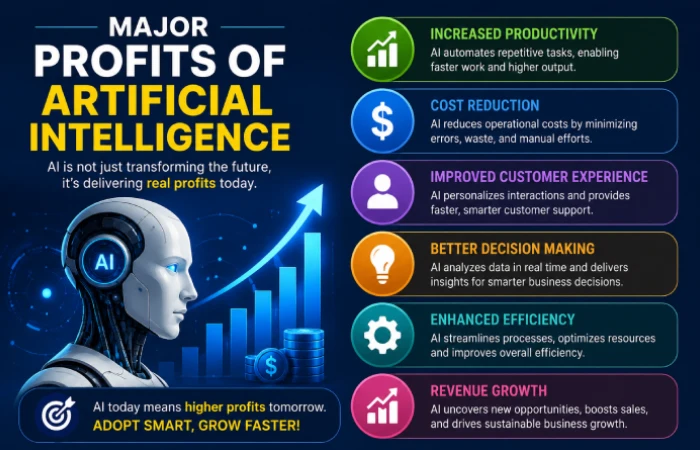
1. Increased Productivity
Automating is one of AI’s most powerful advantages. It is capable of automating repetitive, tedious jobs in an instant, allowing employees to spend their time on tasks that require their creative thinking and engagement, for instance building new customer relations, ideating better business solutions, or taking strategic business decisions. Tedious tasks like data entry, report generation, scheduling, and fundamental customer support activities may be all outsourced to the Artificial Intelligence thereby save time and resources for the organisation.
2. Reduced Operating Costs
There are many areas where technology already has begun to enable the cost efficiencies through automation of processes which previously were manual and time-consuming. Companies using this technology may involve AI to help with tracking equipment, automating supply chains, inventory, and identifying performance.
3. Better Decision-Making
“AI can crunch through a huge volume of data faster than any human could.” “This helps businesses use insights and recognize patterns to make better choices on things like pricing, marketing, capital investments, and inventory. “
4. Improved Customer Experience
AI driven technologies chatbots, recommendation engines and voice assistants have the ability to offer your customers an intelligent, fast and personalized experience. For instance, e-retail stores can use AI technology to recommend products to the online customer as they scroll through the website or past online shopping purchases.
5. New Revenue Opportunities
The AI also gives rise to the emergence of new products and new services. Companies can build services like AI based software, unique personalized service etc, etc. AI may enable the companies to come up with new business model like automatic system etc. In both the large organizations and the new starts ups, opportunities will bloom.
Key Business Benefits of AI
| Benefit | Potential Business Impact |
| Automation | Saves time and increases productivity |
| Data analysis | Supports faster, informed decisions |
| Personalization | Improves customer engagement |
| Cost reduction | Lowers operational expenses |
| Innovation | Creates new products and revenue streams |
| Forecasting | Helps businesses predict demand and trends |
Major Risks of Artificial Intelligence
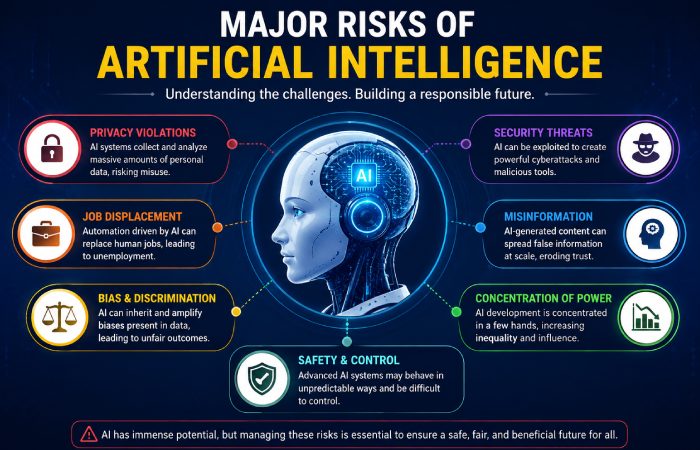
Organizations can better understand and manage AI-related risks by following established frameworks for trustworthy and responsible AI. The NIST AI Risk Management Framework provides practical guidance for identifying and managing these risks.
However, with the benefits come challenges. If a business opts to implement AI without proper safeguards, then it could very well find itself in a rather costly position, both financially and reputationally too.
1. High Implementation Costs
Advanced AI systems typically demand a heavy investment in software, hardware, data, security experts, and a skilled technical workforce. Such resources might not be readily obtainable for small organizations.
2. Job Displacement
Automation might result in decrease of requirement for few repetitive task roles. While AI may even be a source for newer employment opportunities; those workers whose jobs are subject to automation will undergo need for retraining and acquisition of skills.
3. Data Privacy and Security
AI systems are heavily reliant on vast amounts of data, and if not managed well, these systems present significant privacy concerns, unauthorized access or data breaches. Businesses need to take stringent measures when it comes to securing sensitive client and business information.
For more information on protecting sensitive financial information, see Using Artificial Intelligence to Help Keep Your Financial Data Safe.
4. Incorrect or Biased Results
AI can learn incorrect information due to bad, biased, or inaccurate training data. AI can make factual mistakes in their output, which can also be known as a hallucination. This demonstrates the continued significance of human supervision, particularly when AI is utilized in major decisions.
5. Cybersecurity Threats
AI makes it possible to improve cybersecurity, yet crooks are using AI for evermore innovative phishing, malicious schemes and content, as well as automated attacks, etc.
- Legal and Ethical Concerns
The impact of AI spans many areas, including the law of copyright, liability, transparency, discrimination and the misuse of personal information. Regulations regarding AI will no doubt continue to evolve so businesses need to keep pace with the legal changes occurring.
AI Risks at a Glance
| Risk | Possible Consequence |
| High costs | Reduced return on investment |
| Job automation | Workforce disruption |
| Data breaches | Financial and reputational damage |
| Biased algorithms | Unfair decisions |
| AI errors | Poor business decisions |
| Cyberattacks | Security and financial losses |
| Regulatory changes | Compliance costs and penalties |
How Businesses Can Reduce AI Risks
By implementing AI responsibly businesses can take advantage of all there is to offer. To start businesses must identify precisely business problem and whether using artificial intelligence will best help address this.
Organizations must also keep human intervention for critical decisions, use testing methods to identify and eliminate AI errors and prejudices, secure sensitive data and train employees in the use of AI. High security and defined procedures may lower the potential risks.
And more than all, a company must see AI as an aid and not a complete substitution for human intuition.
Conclusion
AI provides us with great opportunities to enhance productivity, lower costs, improve customer experience and unlock new revenue streams. Organizations also need to face concerns with data privacy, security, employment, biased information, inaccurate information, cost and regulation.
The real future impact of AI will be determined not by the speed of adoption, but by its intelligent application by enterprises. Those which integrate AI technology with human involvement, robust security, data quality and ethically sound principles, will stand to reap greater value at the lowest levels of risk.