
Last Updated: August 31, 2026
An Architecture of Internet of Things (IoT) consists of connected devices, sensors, networks, data processing, applications, and users working together. In simplistic terms, the Internet of Things is often defined as nothing more than ‘connected devices’. However, the ‘connected devices’ themselves is not where the greatest value is; it is the IoT architecture that enables physical things to collect data and then send that data to communicate, process and drive action.
Although no definitive, widely recognized IoT architectures have yet been identified, a varying number of network layers have come to be in reference models; for example, some reference models define 3 layers whereas others may define 5 layers.
This Article Belongs to Internet of Things
Table of Contents
What is IoT Architecture?
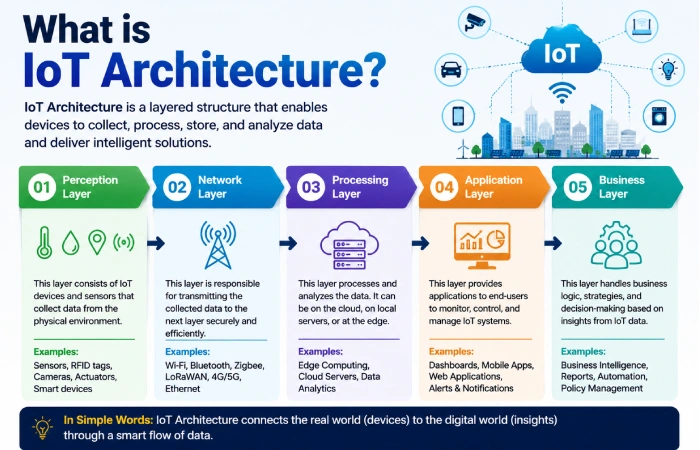
Internet of Things (IoT) architecture refers to the structural configuration that describes how data moves from physical machines to a network, processing stage, applications, and in turn back to a consumer.
A smart temperature sensor measures the current temperature in a room, then sends the measurement across a network to an edge/cloud platform for analysis, and the result is displayed using an app, or the system could actually trigger the air conditioning remotely.
The system is defined by NIST as including various connected devices with “sensing and/or acting functions for interfacing with the physical world.”
3-Layer Architecture of IoT
The layer 3 architecture is an elementary and widely recognized layered architecture model for IoT:
| Layer | Main Function | Examples |
| Perception Layer | Collects information from the physical environment | Sensors, RFID, cameras, actuators |
| Network Layer | Transmits data between devices and processing systems | Wi-Fi, Bluetooth, cellular, Ethernet |
| Application Layer | Provides services and applications to users | Smart homes, healthcare, smart cities |
1. Perception Layer
The physical basis of any IoT solution, consisting in the perception layer including the IoT sensors, actuators, hardware devices used to collect data from the environment and also the actuators used to exert action as a result of decision made, based on received values or inputs from sensors. The latter may also transmit to the actuators physical parameter values like, but not limited to: temperature, pressure, humidity, gas level, presence of motion, GPS position, vibration frequency and level.
NIST describes sensing, computing, communication and actuation as essential components of IoT systems.
2. Network Layer
The network layer carries the collected data from IoT devices to IoT gateways, edge computing systems, or the cloud for further analysis and utilization within cloud applications.
Depending on the network scenario, IoT devices use Wireless technologies like Wi-Fi, Bluetooth, IoT networks, wired connections like Ethernet, etc for transmitting data.
This layer is very important for the reason that an unreliable or not secure connection or network can damage the entire IoT system
3. Application Layer
The Application layer provides IoT services to users and organizations. The Application layer translates processed data into usable information or an action.
Examples include:
- Smart home automation
- Industrial monitoring
- Smart agriculture
- Connected healthcare
- Fleet tracking
- Smart energy management
Five-Layer IoT Architecture
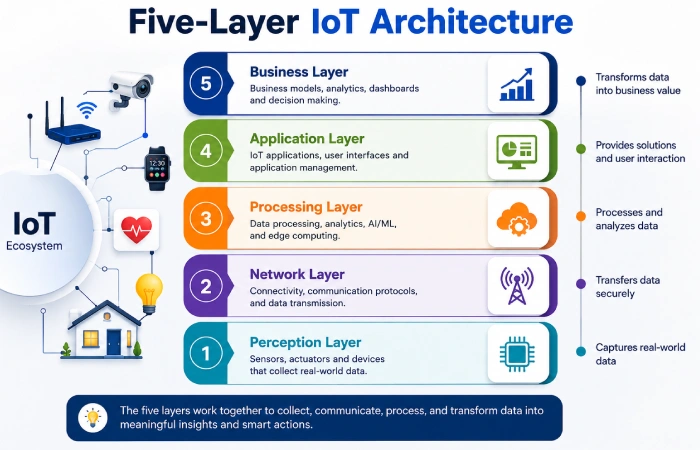
A five-layer architecture is suited to more complex systems to provide better visibility into the data flow of an IoT network.
| Layer | Purpose |
| Perception | Collects data from physical objects |
| Transport | Transfers data between devices and processing systems |
| Processing | Stores, analyzes, and manages IoT data |
| Application | Provides IoT services to users |
| Business | Uses IoT information for business decisions and management |
The five-layer model adds processing and business functions to the basic three-layer approach.
Key Components of IoT Architecture
A practical IoT architecture generally includes several components working together.
IoT Devices and Sensors
Devices communicate directly with physical world – Sensers read info from the real world, where actuators trigger tasks.
IoT Gateway
This gives the device connection to wider networks and can take upon functionalities like protocol translation, filtering of local processing and the enforcement of security policies.
Edge Computing
Instead of sending everything to a central cloud you can do some of the processing on the data collection devices themselves. This reduces the latency of communications and reduces traffic on your network
Cloud or Data Platform
Cloud infrastructure can provide large-scale storage, computing resources, analytics, device management, and application support. However, IoT data does not always need to be processed in the cloud; processing can also occur closer to where data is generated through edge or fog computing. NIST explains how decentralized fog computing can move applications, data analytics, and management closer to IoT devices.
Applications
An application provides IoT data to the user or performs an automatic action based on data that has been processed and interpreted (or converted) by IoT.
For example, projects using a Raspberry Pi to make IoT systems can demonstrate how computing hardware can be integrated with connected sensors and devices.
Security and Management
Security must be an architectural choice rather than an addition after the facts. Important aspects for trusted IoT are; device identity, authentication, access control, secure communication, monitoring and life cycle management. NIST recently produced an IoT best practice guidance covering trusted device on boarding and life cycle management.
How IoT Architecture Works
A typical IoT data flow looks like this:
Physical Environment → Sensors → Gateway/Network → Edge or Cloud Processing → Application → User/Actuator
As a sample within a smart factory, a vibration sensor measures the operations of a machine. The readings of the sensor is forwarded via a gateway towards an edge/cloud platform, where an application provides intelligence through analysis to discover irregular vibration signatures and provides warning alerts to the maintenance crew or sends instructions to shut down the machine.
This explains why an IoT architecture involves more than simply plugging things together-it provides a complete path from a sensor detecting something to the system deciding what to do and then acting on that decision.
Why IoT Architecture Matters
Organizations can develop scalable, dependable, and secure IoT solutions that is convenient to manage using appropriate design in their organization.
It can also support:
- Real-time monitoring
- Automated decision-making
- Predictive maintenance
- Efficient resource management
- Better operational visibility
- Integration between physical devices and digital applications
IoT is also being applied beyond homes and factories, including IoT in the automotive industry, where connected technologies can support monitoring, automation, and vehicle-related services.
However, as per the research, modern IoT reference architectures include explicit reference to sensors, actuators, network devices, gateways, IoT platforms, applications, management, security etc
Conclusion
The architecture of Internet of Things (IoT) provides a basis for connecting real-world entities with computing. There is a simple three layer model-perception, network and application which serves as entry-level for readers to get familiar with primary data processing, in the meanwhile five layer and more granular architectures further introduce data processing, managing, and business functions.
As IoT systems become more complex the architecture must not only consider the communication connectivity and data analysis but also aspects of security, scalability, device administration, edge computing and lifecycle management. Knowledge of each aspect of IoT system architecture facilitates the designing and evaluating of IoT applications in the domains of smart home, healthcare, agriculture, manufacturing, smart transportation and smart city.