
Last Updated: September 1, 2026
Water management requires more data-driven systems to meet the growing challenges faced by industries, utilities and cities to reduce water usage and adapt to variable environmental circumstances. A Transforming Water Management Using Artificial Intelligence-Based Solutions can aid organizations in identifying complex patterns difficult to spot manually from massive datasets of consumption, sensor, infrastructure and weather data.
“AI is not going to do a job for you as an engineer or a water-quality planner or regulator. Rather, AI can work alongside existing staff as a decision-support layer allowing you to assess risk early, triage what’s most important to your maintenance program, and utilize what knowledge exists. Furthermore, recent analysis has highlighted emerging uses for AI in wastewater systems, drinkable water quality, and infrastructure planning.
This Article Belongs to AI Tools
Table of Contents
What is AI-Based Water Management?
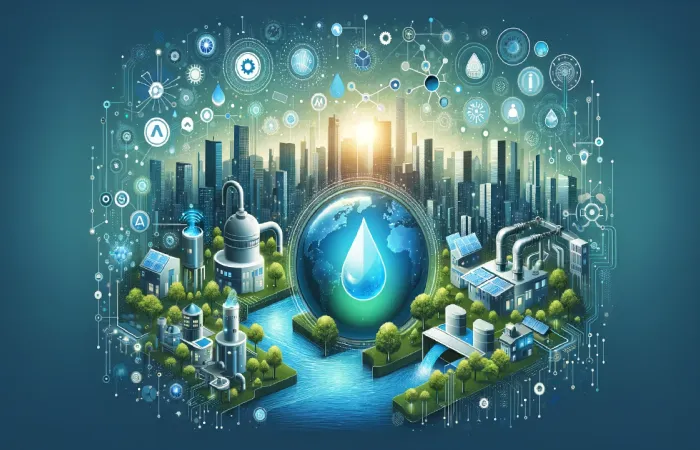
AI for water management combines artificial intelligence with smart water devices which involve Internet of Things (IoT) sensors, smart water meters, geographic information systems (GIS) technology, automated control units and cloud-based data storage.
The ML systems analyze historical as well as real-time data in order to predict demand, recognize atypical usage or alert for a potential infrastructure issue. For example, a jump in flow rates could mean that water was suddenly lost in a supply line, prompting an inspection team to look for a potential leak.
The approach can be applied across several areas:
| Application | How AI Can Help |
| Leak detection | Identifies unusual pressure, flow or consumption patterns |
| Demand forecasting | Predicts likely water requirements |
| Water-quality monitoring | Detects abnormal readings and emerging patterns |
| Predictive maintenance | Helps priorities inspection of ageing assets |
| Irrigation | Supports data-based watering schedules |
| Wastewater management | Assists monitoring and process optimization |
| Resource planning | Supports scenario analysis and allocation decisions |
How AI Is Transforming Water Management
1. Smarter Leak Detection
Leaky pipes, compromised joints and old infrastructure might be contributing to water loss – but these can often lead to different patterns of flow and pressure, which can be detected using AI model by comparing the incoming data against standard flow and pressure readings for the area.
Research published in Water Research in 2026 has specifically examined AI methods for detecting and locating both abrupt and developing leaks in water distribution networks.
However, normally an AI alarm should only be used as a trigger for investigation rather than conclusive evidence of the leak. It could be triggered due to maintenance work or because there is an abnormal demand on demand and / or there has been a failure on a sensor.
2. Better Water-Quality Monitoring
Sensors can continuously measure parameters such as temperature, turbidity and pH or other water quality indicators. AI will be able to receive these values and detects atypical combinations or variations warranting detailed scrutiny.
It is good that traditional sampling provides a snapshot where and when the result have come in but connected measurement supplies a more or less continuous picture.
AI predictions have a role to play in supplementing conventional laboratory tests, water-safety protocols and regulatory guidelines. The World Health Organization revised 2026 guidelines on drinking-water remain firm in their reliance on risk management, monitoring and health-based methods of water protection.
3. Predicting Water Demand
Machine-learning models use historical consumption patterns and the changing environment, season, consumer behavior, industry behavior, and the population to predict water demand in the future
Improved forecasting may facilitate more efficient utility planning in regard to pumping, storage and treatment capacity. There may be fewer cases where extraneous pumping energy is utilized, due to the possibility of pumping on demand.
For a broader understanding of how AI is influencing different aspects of society and technology, see How Artificial Intelligence Can Change the Future.
4. Predictive Maintenance
Rather than being use to predict when equipment might break down, AI could also identify assets behaving unpredictably. Information gathered from pumps, meters, valves, and other machinery could be screened for patterns typical of a fault developing.
This does not replace the need for inspections. But maintenance workers could use it to determine which of their assets really need an inspection before all the other. This may use maintenance budget better.
AI Water Management Workflow
A practical AI implementation generally follows this process:
Sensors and operational systems → Data collection → Data cleaning → AI analysis → Risk or demand prediction → Human review → Operational action → Performance monitoring
The better the source data, the better the result will be. Calibrated sensors, missing values and unreliable past history all degrade the model.
Expectations: What Can Organizations Realistically Expect?
AI can facilitate visibility and faster decisions, but results vary widely among projects. An AI effort with accurate sensors, good history, and a well-defined operating problem is much more likely to deliver value than an AI project implemented without solid data foundation.
The use of AI and data needs to take into account cybersecurity, data governance, the exploitability of models, human resource training, and continued upkeep and maintenance. In a 2026 systematic review of over 100 peer reviewed papers it identified that the uses for AI in water governance were increasing however it was important to remember the limitations for exploitability, trustworthiness, and linking them into decision-making processes and implementation in the real-world setting.
For a balanced overview of the opportunities and potential drawbacks of AI, readers can also explore Profits and Risks of Artificial Intelligence.
Pros and Limitations
| Advantages | Limitations |
| Faster analysis of large datasets | Dependent on data quality |
| Earlier anomaly detection | False alarms can occur |
| Better demand forecasting | Models require monitoring and updating |
| Supports predictive maintenance | Initial infrastructure investment may be significant |
| Can improve operational visibility | AI does not replace expert judgement |
| Enables more data-driven planning | Cybersecurity and privacy require attention |
Practical Example
A water network in a city equipped with pressure sensors and smart water meters. When the water system records an average usage pattern during the day. An artificial intelligence model detects an increase in water usage overnight in one neighborhood in addition to a strange change in pressure.
Instead of deploying a whole maintenance team to examine the whole network the utility could allocate the investigation to only the area concerned. If a damaged pipe is later found and identified the AI program has assist in targeting and a quicker response in operations can be put in effect
Who Can Benefit From AI-Based Water Management?
Water utilities, municipalities, agricultural operations, plants, businesses and environmental agencies and engineers have all seen real benefits by using AI-enabled forecasting and monitoring solutions.
Smaller organizations might start off addressing a narrow use case of demand forecasting or anomaly detection instead of going all the way to digital transformation. Even the WHO guide acknowledges there are unique challenges facing smaller water supplies in terms of operations, technology and resources that will require context-appropriate technologies.
Conclusion
Revolutionize water management with artificial intelligence-based solutions Providing you with the first truly pragmatic solution for creating data-driven water systems, artificial intelligence can facilitate proactive initiatives such as leak detection, demand forecasting, and water-quality monitoring, and predictive maintenance, while assist to empower teams of allocating precious resources.
Our strongest outcomes are likely to arise by leveraging AI with robust sensing, solid engineering, human supervision and proper water safety. Hence, we should think of artificial intelligence as just one tool in a suite of effective water solutions for a sound water-based society.