
Last Updated: September 1, 2026
The term Internet of Things, or IoT, is considered one of the essential and significant breakthroughs of the Digital Age. It refers to a growing network of interconnected physical devices-cell phones, appliances, industrial devices, and vehicles that are networked to gather as well as exchange data and perform actions accordingly without human interference.
Internet of Things (IoT) now means more than just connecting devices to the internet; It integrates devices equipped with sensors and connectivity features and enabled by computing power and intelligence to operate in systems for remotely observing and assessing situations or environments and for identifying trends and making automated decisions. With this interconnected devices-smart home, intelligent car, intelligent farming, smart factory, remote health check, smart city-these kinds of devices represent the powerful influences of the Internet of Things to our life.
This Article Belongs to Internet of Things
Table of Contents
What is the Internet of Things?
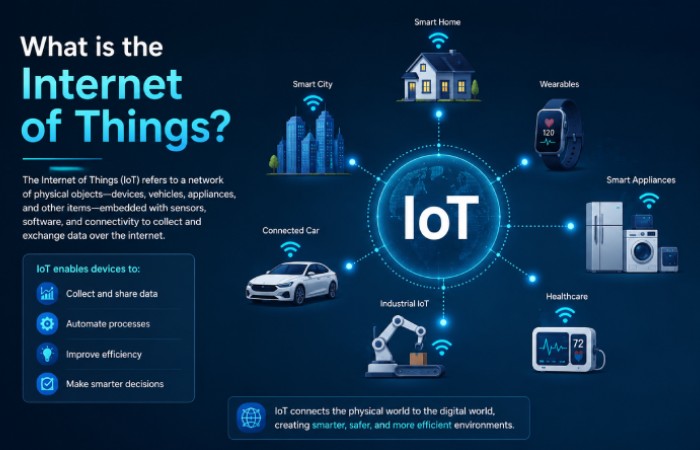
The Internet of Things, or IoT, is a web of interconnected physical objects that transmit data. These devices have technology embedded in them to send or receive the data they collect to others on their network. These interconnected devices are often referred to as connected or IoT devices. A device could have a temperature sensor, motion sensors, pressure sensors, location sensor, humidity sensor, energy consumption sensor, etc.
This gathered data then is transmitted to another device, an edge device or a cloud. Then through analysis, the household temperature with a smart thermostat could be calculated and controlled accordingly.
The Internet of Things connects physical objects with sensors, software, and network technologies to collect and exchange data. The International Telecommunication Union (ITU) provides an authoritative overview of IoT and its role in connected technologies.
The fundamental concept can be summarized as:
Physical object → Sensor → Connectivity → Data processing → Analysis → Action
This cycle allows physical environments to become measurable, observable, and increasingly automated.
How Does IoT Work?
IoT environments are based on multiple interconnected layers. Although the architectures may vary with the intended use of IoT systems, there are five commonly encountered layers: devices and sensors, connectivity, data processing, applications, and security.
1. Sensors and Devices
The first stage involves collecting information from the physical world.
IoT devices may use sensors for:
- Temperature
- Humidity
- Motion
- Light
- Pressure
- Sound
- Location
- Air quality
- Heart rate
- Vibration
- Energy consumption
- Proximity
For example, a manufacturing machine can have vibration sensors installed which regularly collect data about its operating status.
IoT development can also be explored using affordable hardware platforms such as Raspberry Pi for making IoT projects, which can connect sensors, process data, and communicate with other devices.
2. Connectivity
After data is gathered, it has to be transmitted to another system for processing. There are multiple types of communications that can be achieved with IoT devices based on needs.
Some types of connectivity for IoT are Wi-Fi, Bluetooth, cellular, Ethernet, Zigbee, Z-Wave, LPWAN, and modern cellular IOT technology. The requirements that determine which type of technology to use may range from range requirements to power consumption to bandwidth requirements, costs, and reliability.
3. Data Processing
IoT data can be processed by the devices themselves, by an edge device gateway, or in the cloud. For example, IoT device data can tell if it’s above a certain temperature threshold (this is a simple processing task), or whether abnormal behaviour is going on, or even anticipate certain future events (via use of some learning algorithms).
4. Data Analytics
Data can be turned into something useful when compiled. IoT businesses use collected data for trend analysis, aberration detection, optimizing business operations, and predicting device failure, customer behaviour, and many more.
5. Applications and User Interfaces
This is the last interface, the one for the humans. This can be a mobile App, a web application, an industrial controller, medical software or any automated system. For instance, a logistics manager could monitor the position of vehicles and fuel consumption using an IoT-driven dashboard.
6. Automation and Action
The best IoT systems don’t just collect data. They do something with it. An irrigation system with the right setup can detect dry soil and just start watering.
An industrial system can learn that a particular machine has an unusual vibration pattern, and just schedule maintenance for it. Being able to translate data into an automated response is a big part of why IoT is so useful.
Major Components of an IoT System
| Component | Function | Example |
| Sensors | Collect physical information | Temperature sensor |
| IoT device | Captures and communicates data | Smart meter |
| Connectivity | Transfers data | Wi-Fi or cellular |
| Gateway | Connects devices to larger networks | Industrial gateway |
| Edge computing | Processes data close to its source | Factory edge server |
| Cloud platform | Stores and processes large datasets | IoT cloud platform |
| Analytics | Converts data into insights | Predictive maintenance model |
| Application | Provides user interaction | Smart-home dashboard |
| Actuator | Performs an action | Smart valve |
| Security | Protects devices and data | Device authentication |
Examples of the Internet of Things
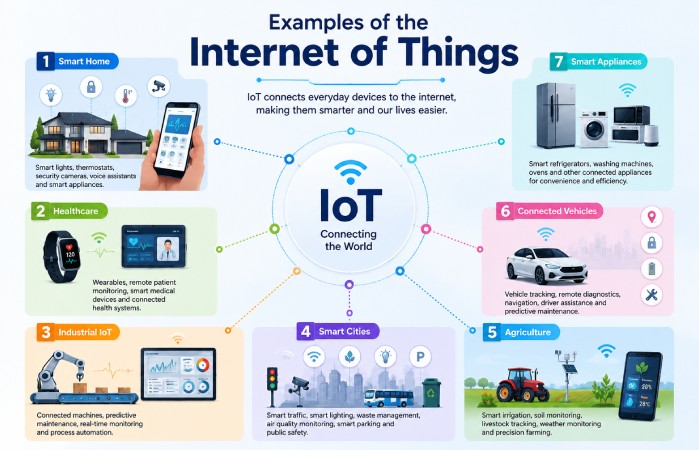
IoT is an industry that can span more than one sector. It could literally be applied anywhere that physical objects need to be monitored or linked and controlled.
Smart Homes
Smart homes are among the most visible examples of IoT.
Connected devices can include:
- Smart lights
- Smart thermostats
- Security cameras
- Smart locks
- Connected televisions
- Smart speakers
- Robot vacuum cleaners
- Smart appliances
- Smoke and carbon-monoxide detectors
- Energy-monitoring devices
Such devices are interlinked and react automatically to user preferences,. For instance, automatically switching off smart lights once motion sensors show that no one is present. Connecting your burglar alarm to send an alert.
Healthcare and Medical IoT
The healthcare sector is deploying more connected devices to keep track of and monitor patients and run facilities smoother. Wearable IoT and medical devices can record data including heart rate, temperature, blood oxygen levels, activity, and measurements to keep track of patients and their symptoms. Also, linked machines can help track inventory, monitor workplace environments, monitor medical assets, and streamlines operations to avoid the loss of the medical instruments within a facility. Essentially, the Internet of Medical Things or IoMT.
Industrial IoT
IIoT -Industrial Internet of Things takes connected technologies beyond the office in to production, manufacturing, energy, mining, transportation, and logistics industries. In a factory for example, businesses can connect machines and sensors to gather real-time data about the functioning of industrial equipment. Predicting issues is one of the most significant IIoT applications: Machine learning models analyzing the collected data can signal when a piece of hardware might be about to break down – helping companies optimize maintenance schedules and avoid unexpected downtime.
Agriculture
These IoT applications for agriculture come in the form of connected sensors, weather monitoring devices, drones, crop monitoring, as well as livestock management tools. IoT technology can include soil moisture sensors which can be used to irrigate accurately based on its contents in its environment.
IoT-enabled agriculture can contribute to:
- More efficient water usage
- Crop monitoring
- Livestock tracking
- Weather analysis
- Automated irrigation
- Equipment monitoring
- Improved resource management
This approach is sometimes called smart farming or precision agriculture.
Smart Cities
Cities can use IoT to monitor and manage infrastructure.
Potential applications include:
- Smart street lighting
- Traffic monitoring
- Parking management
- Waste management
- Public transportation
- Air-quality monitoring
- Water management
- Energy management
- Infrastructure monitoring
For example, connected streetlights can adjust their operation based on environmental conditions or usage patterns. These applications are also part of the broader development of smart cities shaped by IoT and AI, where connected infrastructure can support more efficient urban services.
Connected Vehicles
Modern vehicles contain numerous sensors and electronic systems that generate substantial amounts of data.
Connected vehicles can support:
- Vehicle diagnostics
- Navigation
- Fleet tracking
- Driver assistance
- Remote monitoring
- Usage-based services
- Predictive maintenance
The combination of IoT, artificial intelligence, and advanced vehicle technologies is also contributing to the development of increasingly automated transportation systems. IoT is therefore changing the face of the automotive industry by enabling connected vehicles and data-driven transportation services.
IoT vs. Traditional Internet
The traditional internet primarily connects people, computers, and digital services. IoT extends this concept to physical objects.
| Traditional Internet | Internet of Things |
| Primarily connects computers and people | Connects physical objects and systems |
| Human interaction is often central | Devices can communicate automatically |
| Data is frequently generated intentionally | Data can be generated continuously by sensors |
| Applications are mainly digital | Digital systems interact with physical environments |
| Automation is possible | Automation is a central IoT capability |
That line isn’t absolute. Smartphones, tablets, computers and a growing list of other devices operate within a massive global network of digital information that includes connected devices.
Benefits of the Internet of Things
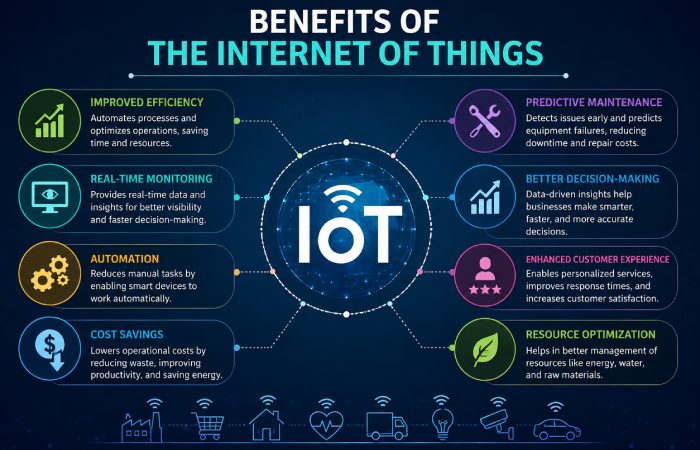
IoT can create many advantages to customers, corporations, governments, and industrial companies.
Improved Efficiency
IoT systems will continuously track activities and identify where downtime time, energy, materials, or resources can be saved.
Automation
The connected device can carry out tasks using pre-programmed rules or using smart logic.
Automation can reduce repetitive manual work and improve consistency.
Real-Time Monitoring
Traditional monitoring is usually based on fixed inspection intervals. IoT can bring you even closer to real-time data, or even continuous updates. This is very useful for things like machinery in industry, transportation, environments, and infrastructure.
Predictive Maintenance
This technology makes it possible to identify alterations in the machine’s performance before there’s even a catastrophic breakdown. Instead of passively observing a machine until it’s broken, businesses use their data to observe issues earlier on.
Better Decision-Making
IoT device operations produce extensive data outputs; the analysis of which can allow a company to gain valuable understanding of operation efficiency, usage of equipment, behaviors of customers and status of equipment.
Improved Customer Experiences
Connected products can deliver a higher level of personal service and greater user experiences. For instance, intelligent devices can learn your usage patterns and automatically reconfigure settings, based upon your needs and requirements.
Resource Optimization
Through the deployment of IoT, organizations can track consumption of electricity, water, fuel, raw materials and many more resources. With greater insight into the consumption, resource allocation could become more efficient, thus increasing operational efficiency.
Challenges and Disadvantages of IoT
Despite its benefits, IoT introduces significant technical, financial, and security challenges.
Security Risks
Each connected device has the potential to be used as a means of entry. If weak passwords are used, or the software is not up-to-date; if inefficient communication is implemented, or devices are not configured to best practices, then an IoT system can be vulnerable to attack. Thus, security must be embedded within the IoT device’s life cycle.
Privacy Concerns
IoT technology has the capability to gather extremely rich information on the environment and on behaviour. Smart cameras, smart watches, connected car solutions or smart homes are likely to provide data on people’s habits. They can disclose interesting individual behavior. Companies should define what they collect, the purpose of collecting that data, its retention period, and access rights.
Data Management
Billions of devices connected can generate so massive amounts of data. It also requires companies to be in charge of storing, processing, analyze and manage this data efficiently and securely.
Connectivity Dependence
Many IoT apps must depend on reliable network access. When connected systems cannot connect, many of these systems’ capabilities diminish – especially applications that rely on remote cloud services.
Cost
An investment is often made in the sensors, connectivity, platform, software, security and maintenance of an IoT solution, along with staff training, when scaling. Initial investment can be high, even if long-term benefits are significant.
IoT Security
Security is one of the most important aspects of IoT.
A comprehensive IoT security strategy can include:
- Strong device authentication
- Secure communication
- Encryption
- Secure software development
- Regular firmware updates
- Network segmentation
- Access control
- Vulnerability monitoring
- Logging and threat detection
- Secure device retirement
The security of a system or product should not be applied after deployment. It must be applied during the design, development, manufacture, deployment, operation and end-of-life stages of a device.
The Role of Artificial Intelligence in IoT
The fusion of AI and IoT is also called the AIoT, Artificial Intelligence of Things. IoT produces data and AI can assist in analyzing the data and producing predictions from it. Let’s assume you had many thousands of sensors in a factory floor.
IoT might be gathering vibration, pressure, and temperature and power consumption.
With appropriate AI models applied, it would be possible to analyze all the data gathered to detect any trends corresponding to a particular piece of equipment breaking down.
The combination can create systems that move from:
Sense → Collect → Analyze → Predict → Act
This is more powerful than simply collecting information.
AI can also support anomaly detection, demand forecasting, image analysis, optimization, personalization, and automated decision-making.
Edge Computing and IoT
Although cloud computing has played a vital part in IoT, not every data can be transmitted to the remote cloud system. Therefore, edge computing is to make most of data processing to near to where data is produced, say an industrial camera recognizing safety issues at local location instead of transmitting frame after frame to the remote data center.
Edge computing can provide:
- Lower latency
- Reduced bandwidth requirements
- Faster responses
- Greater resilience
- Potentially improved privacy
In many IoT systems in modern days, cloud and edge compute actually complement each other rather than to compete.
IoT and Big Data
IoT and big data have a strong relationship. One device, perhaps in one small thing, producing limited data isn’t so overwhelming. Yet multiply this by a million or more sensors and the result is vast data sets.
Businesses need ways to connect to device networks, then filter and then store the data. IoT data can also be analyzed, often to find valuable insights within the patterns the stream produces.
IoT in Business
Internet of Things can be implemented in a variety of industries, giving an improvement to the operation visibility and enabling new services in a market. The retailer may use connected systems to report the stocks and the environment. Or the transport company may develop an advanced tracking service, by connecting various elements and allowing to know where a vehicle or a shipment is.
While manufacturers can use the IoT to oversee how their machinery is performing, utility companies may leverage connected meters and devices to gauge consumer behaviour. As such, IoT can contribute to both business and operational transformation, such as moving from supplying goods to offering ongoing connected services in addition to connected features such as a subscription, predictive insights or ongoing monitoring. IoT can also be applied to connected digital services and platforms, including systems designed around online connectivity and user interactions such as Miototo Slot.
IoT Architecture
A simplified IoT architecture can be represented by four major layers. For a deeper explanation of how these layers and components fit together, see the architecture of the Internet of Things:
| Layer | Purpose |
| Perception layer | Collects information from the physical environment |
| Network layer | Transmits data between devices and systems |
| Processing layer | Stores, analyzes, and manages information |
| Application layer | Delivers services and business functionality |
More sophisticated architectures may include separate layers for device management, security, analytics, identity, edge computing, and business processes.
Future of the Internet of Things
The future of IoT will probably look at the merging of a bunch of different technologies together, it’s not just about things in their own right.
Important developments include:
More Intelligent Devices
Devices have continued to increase their ability to handle more complex processing “on board”
Greater Use of AI
AI will become even more useful for IoT in finding trends, forecasting results, and driving automatic decisions.
Expansion of Edge Computing
Demand for rapid response times in many applications is pushing many computing activities into locations much closer to devices.
Improved Connectivity
Advances in cellular networks, low-power networking, and other communication technologies will support new IoT applications.
Digital Twins
The ‘digital twin’ is an accurate representation of an existing physical asset, process or system, which can be informed and updated by real-world data. A digital twin of an industrial machine, for example, will include information such as that gained from sensors to provide an insight into its operational state and to enable certain parameters or conditions to be simulated.
Autonomous Systems
The combination of sensors, connectivity, AI, and actuators will enable increasingly autonomous systems in factories, transportation, agriculture, logistics, and other environments.
Internet of Things: Advantages and Disadvantages at a Glance
| Advantages | Disadvantages |
| Real-time monitoring | Security vulnerabilities |
| Automation | Privacy concerns |
| Improved efficiency | High implementation costs |
| Predictive maintenance | Complex data management |
| Better decision-making | Interoperability issues |
| Resource optimization | Dependence on connectivity |
| Personalized services | Long-term maintenance requirements |
| Operational visibility | Device lifecycle challenges |
Conclusion
The Internet of Things, or IoT, is a basic but disruptive paradigm that allows digital systems to connect with the physical world around them. IoT allows anything – sensors, gadgets, machines, cars, infrastructure, healthcare monitors, and appliances-to be intelligent and communicate with other devices and services in real-time to generate insights and to automate tasks. It spans from smart homes to smart factories, hospitals, farms, traffic management, and transportation systems as well as whole cities.
But the true value of IoT is created not just by plugging more devices online; it is the fusion of connectivity with reliable data, analytics, big data processing, artificial intelligence, edge computing, strong cybersecurity, and automation.
More than simply an array of internet-connected devices, Internet of Things offers an intelligent, connected environment where physical objects, machines, people, pets, and devices can receive, understand, and react to the world around them.