
Last Updated: August 31, 2026
In the automotive industry, a drastic revolution is happening where automobiles are rapidly getting interconnected, smarter and driven by data. Internet of Things (IoT) technology is the core of this disruption as vehicles are getting increasingly interconnected with sensors, smartphones, cloud networks, road infrastructure etc. It implies that cars of the new era would serve more than just travel purposes but also collect data and relay the same to other connected things and would also act based on changing dynamics.
Thanks to IoT, vehicles’ design, production, driving and maintenance are being completely revolutionized – from being connected cars to having predictive maintenance and from having better safety to better traffic flow.
This Article Belongs to Internet of Things.
Table of Contents
What is IoT in the Automotive Industry?
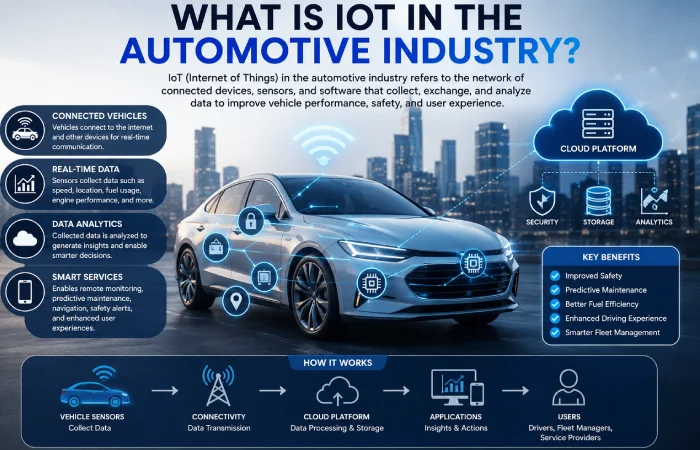
In the automotive sector, IoT utilizes connected sensors and devices, software, networks, and the cloud to receive and transfer vehicle related information.
IoT technology, has the ability to monitor engine performance, tire pressure, fuel efficiency, GPS, driving characteristics, road surface, and more; This data collected can be analyzed to yield important information for the owner, manufacturer, and service companies/fleet owners.
How is IoT Changing the Automotive Industry?
1. Connected and Smarter Vehicles
The Internet of Things has also begun to influence our automotive lives more noticeably with the development of connected vehicles. These cars are able to communicate with smartphones, navigation systems, cloud systems and other connected devices.
Connected systems allow drivers to check the status of their cars from afar, track locations, unlock or lock doors and get notification alerts via associated apps. The vehicle’s navigation systems are for managing everyday commute with routes, travel time, traffic information as well as feature customization.
2. Predictive Maintenance
In conventional vehicle maintenance systems, the frequency of service is mostly set based on the mileage of the vehicle. IoT has become instrumental in developing predictive maintenance.
Continuous monitoring is implemented through sensors for various components including the engine, battery, brakes and tires. Where unusual operations occur, it will alert the driver and/or the service center, prior to a major breakdown occurring.
| Traditional Maintenance | IoT-Based Predictive Maintenance |
| Based mainly on fixed schedules | Based on real-time vehicle data |
| Problems may be discovered during servicing | Potential problems can be detected earlier |
| More preventive than predictive | Predicts component issues using data |
| Limited vehicle monitoring | Continuous monitoring through sensors |
3. Improved Road Safety
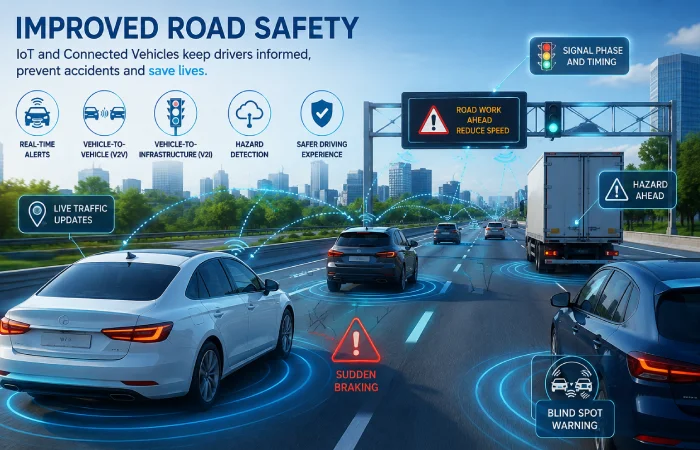
Safety is one of the core use cases IoT technology will focus on. Vehicles can communicate with each other sharing real-time data about road traffic, dangers, sudden braking. Also road events will be reported via IOT devices.
Vehicle sensors, with the networked systems, inform the drivers about the potential threats and minimize the risk of accidents. The IoT devices also ensure the operation of various automotive assistance features. They convey live data of vehicle and environment.
Vehicle-to-everything (V2X) communication allows vehicles to exchange information with infrastructure, other vehicles, and road users. These connected communications can support safer and more efficient transportation systems.
4. Better Fleet Management
Companies involved in taxi services, delivery business, logistic, fleet of trucks can opt for IoT devices which are equipped with remote sensing feature to keep a watch on the vehicle.
Using these systems enables the tracing of vehicles, fuel, driving habits, servicing and goods so that companies can track deliveries and optimize routes, use less fuel and decrease expenses.
5. Smarter Traffic Management
IoT is not limited to the single vehicle in isolation. Connected cars can become an ecosystem of intelligent transportation.
Cars, traffic lights, parking devices, cameras, and traffic and transport infrastructure are capable of trading information. The traffic can inform you about where the traffic jam currently lives and how to avoid it or to smooth out traffic.
For a broader look at how IoT can connect vehicles and infrastructure within urban environments, see how IoT and AI are shaping smart cities.
6. Enhanced Driver Experience
The IoT also adds another layer of customization for vehicles, with connected infotainment services able to offer car users everything from a seamlessly integrated smartphone to an entertainment console, as well as virtual personal assistants and navigational aids and tools.
The vehicle data can assist systems in learning user preferences, enabling better user specific recommendations and personalized experiences, and making driving as natural as any other connected device.
7. Changes in Automotive Manufacturing
Automotive manufacturing is just as profoundly affected as the vehicle itself by IoT. Connected machines and sensors collect data throughout the production line, monitoring equipment function, stock levels and product quality.
Real-time production data available to the manufacturer to detect problems in equipment at an early stage and remove bottlenecks. By this means, not only will efficiency be increased but possible unplanned downtime will also be reduced.
8. Support for Electric and Autonomous Vehicles
The usage of IoT is key for electric, as well as autonomous vehicles. Through the network, systems can monitor the status of batteries, charges, power consumption levels, vehicle performance, etc.
With fully automated vehicles, this information, provided by communication among sensors, vehicles, infrastructure, and cloud platforms, as well as between them, may give further valuable info. Such info can help in their decision-making and support their optimal control and transportation management.
Key Benefits of IoT in Automotive
| IoT Application | Major Benefit |
| Connected cars | Improved convenience and communication |
| Predictive maintenance | Earlier detection of vehicle problems |
| Telematics | Real-time vehicle monitoring |
| Smart navigation | Better route planning |
| Fleet management | Improved operational efficiency |
| Vehicle-to-everything communication | Better awareness of traffic and road conditions |
| Connected manufacturing | More efficient production |
| EV monitoring | Better battery and energy management |
Challenges of IoT in the Automotive Industry
Even with its many advantages, implementing IoT has brought some of its own challenges. Security and data privacy are issues of significant importance because connected vehicles generate and emit large volumes of data.
In addition, manufacturers must also manage a range of issues in system capability, connection reliability, updates to their connected system software, management of the associated data, and costs.
For those interested in building or experimenting with IoT systems, Raspberry Pi can be used to make IoT projects and explore how connected devices collect and exchange data.
The Future of IoT in Automotive
In the coming future of Automotive IoT, may witness higher integration among automobiles, infrastructure, cloud-server networks and smart cities. Capabilities and functions can be added to a connected vehicle by the development of: Vehicle-to-Everything (V2X), Artificial Intelligence (AI), edge computing and 5G connectivity.
The major change here is that vehicles are transitioning from single self-standing machines into interconnected digital devices. IoT, then, will continue to impact not only how vehicles are driven but also how they are manufacture, maintain, utilize and deploys.
To understand how the different components of an IoT ecosystem work together, you can also explore the architecture of the Internet of Things.
Conclusion
IoT is changing the face of the automotive industry by making vehicles more connected, intelligent, efficient, and responsive. Its applications range from predictive maintenance and connected services to fleet management, road safety, smart traffic systems, and electric vehicles.
In addition to the challenges in the field of security, privacy, connectivity, and implementation costs. The convergence between IoT and AI, cloud, and ITS technology forms the basis of next-gen connected mobility.