
Last Updated: August 31, 2026
Nowadays, the Raspberry Pi is probably the most popular and widely used platform for IoT projects. Its small size, inexpensive nature, its operating system based on Linux, its GPIO pin headers and a whole lot of popular programming languages such as Python, which has strong support, are very valuable for both students and hobbyists, and increasingly for both developers and even businesses.
Raspberry Pi can be the brain for a system to communicate across devices over the internet, which collect data from sensors, process the information received from the sensors and communicate it through the internet over the cloud to some application or system.
This Article Belongs to Internet of Things.
Table of Contents
What is Raspberry Pi in IoT?
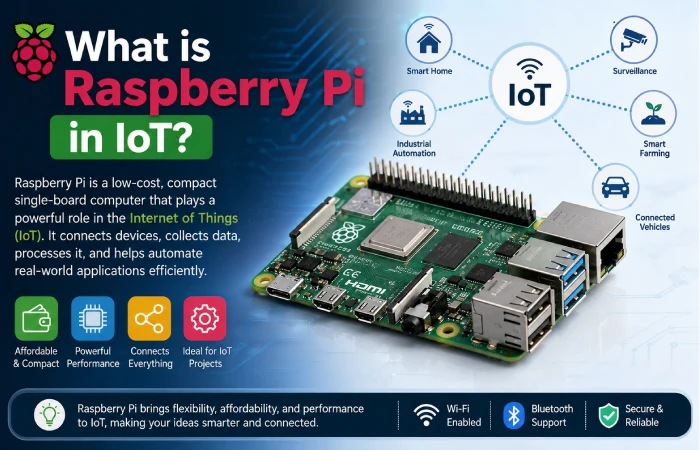
The Raspberry Pi is an affordable, single-board computer. It’s manufactured by the Raspberry Pi Foundation. Unlike a simple microcontroller, it is a fully functional computer.
Physical devices and sensors can also be interfaced with software applications or cloud platforms through the Raspberry Pi within an IoT architecture. As an illustration of this, data collected from a temperature sensor that is attached to a Raspberry Pi may be obtained, analyzed and the relevant temperature value be transferred across the network to a dash.
For a broader understanding of connected devices and their role in modern technology, see Internet of Things (IoT).
How Does Raspberry Pi Make IoT Possible?
Raspberry Pi supports several important functions required for IoT systems.
| Raspberry Pi Feature | Role in IoT |
| GPIO pins | Connect sensors, LEDs, motors and other hardware |
| Wi-Fi/Ethernet | Provides network connectivity |
| USB ports | Connect external devices and peripherals |
| Python support | Enables IoT programming and automation |
| Linux OS | Supports applications, databases and networking |
| Camera support | Enables image and video-based IoT applications |
| Low power consumption | Suitable for many continuously running projects |
It’s the integration of computing, connectivity and hardware interfaces that allow Raspberry Pi to work well as an edge device, gateway, controller or a local server.
Key Components of a Raspberry Pi IoT System
A typical Raspberry Pi IoT project contains several components:
- Raspberry Pi board: It performs computing and controls connected hardware.
- Sensors: Sensors monitor variables like temperature, humidity, motion, light, pressure, air quality
- Network connection: The raspberry pi can be used to connect to other computers servers or cloud services through WIFi or through ethernet.
- Software: Various software can process and send IoT data, including Python, Node.js, databases, APIs etc.
- Cloud or application layer: Information that has been collected may then be visualized and archived using mobile apps, dashboards or Web applications.
Understanding how these components fit together can be explored further in the architecture of Internet of Things.
Raspberry Pi IoT Applications
Raspberrys Pi can be used across many IoT scenarios.
|
Application |
Example |
| Smart home | Automated lights, security systems and temperature monitoring |
| Agriculture | Soil moisture and environmental monitoring |
| Healthcare | Remote monitoring prototypes and connected equipment |
| Industrial IoT | Machine monitoring and data collection |
| Smart cities | Environmental and traffic monitoring |
| Education | IoT programming and robotics projects |
| Security | Camera-based monitoring systems |
Raspberry Pi-based IoT systems can also support connected transportation and mobility solutions, similar to the concepts discussed in IoT changing the face of the automotive industry.
Advantages of Using Raspberry Pi for IoT
1. Affordable Development
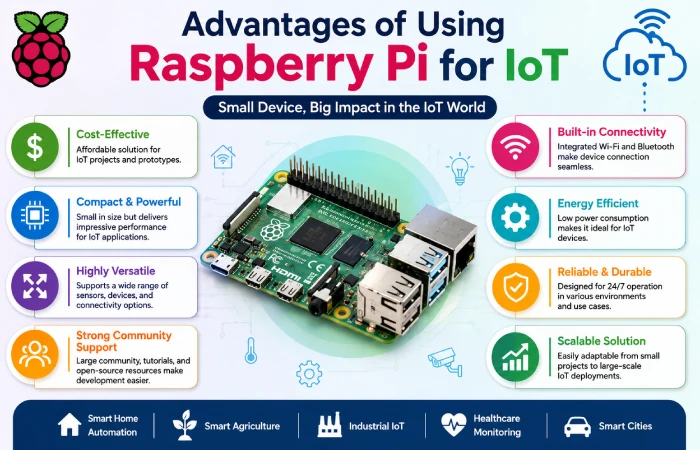
With Raspberry Pi, you get full computer power without the expensive price. Hence, these devices come in handy when prototyping and educational purposes.
2. Easy Programming
Python is one of the best and most commonly used programming languages by Raspberry Pi hence it is beginner-friendly for developers. You also could use different programming languages and frameworks as per requirements.
3. Hardware Connectivity
Raspberry pi communicates to external electronic components (sensors, relays, screens, motors) using the interface of the GPIO.
4. Internet Connectivity
Many Raspberry Pi boards have a built-in network, making connection of your IoT to local network and Internet services easy.
5. Large Developer Community
There’s an extensive community where you can find tutorials, libraries, documentation and project examples that could save time.
Raspberry Pi vs. Microcontroller for IoT
Raspberry pi is not suitable for some internet of things devices, however Microcontrollers (such as Arduino and ESP32) could be the suitable candidate when extremely low power, fast start-up times, and control of a few sensors is needed
| Factor | Raspberry Pi | Microcontroller |
| Computing power | Higher | Generally lower |
| Operating system | Can run Linux | Usually firmware-based |
| Power consumption | Usually higher | Usually lower |
| Complex applications | Excellent | Limited |
| GPIO control | Yes | Yes |
| Suitable for edge computing | Very suitable | Suitable for simpler workloads |
| Cost | Moderate | Often lower |
Challenges of Raspberry Pi in IoT
Although it’s suitable, RPi does have some drawbacks. The power consumption of the Raspberry Pi is usually greater than that of a small microcontroller. The power consumption may a critical issue for a battery-supplied IoT device. As RPi has a full operating system that can connect to a network, security must be carefully considered.
Developers should use strong authentication, secure communication, regular software updates, and appropriate network controls when deploying Raspberry Pi in connected environments.
A Raspberry Pi used for some mission critical use like industrial applications maybe requires a correct power management, protection of the storage, monitoring, redundancy.
How to Build a Simple Raspberry Pi IoT Project
A basic project can follow these steps:
- Choose an IoT use case.
- Select a Raspberry Pi model and compatible sensor.
- Connect the sensor through GPIO or another supported interface.
- Install the operating system and required software.
- Write a Python program to collect sensor data.
- Process or store the data locally.
- Connect the Raspberry Pi to a cloud service or dashboard if required.
- Add security controls and test the system.
Conclusion
By combining computing power, hardware connectivity, networking and software freedom in a small package, Raspberry Pi offers a more affordable way of building and prototyping IoT solutions. Whether for smart homes, smart agriculture, industrial control, or an educational tool it is proving to be key component in many IoT architectures.
Raspberry Pi-based solutions can also contribute to connected urban environments, where IoT technologies are increasingly combined with AI for monitoring, automation and data-driven services. Learn more about smart cities and how IoT and AI are shaping urban environments.
Ultimately, the decision for Raspberry Pi must be taken in the context of the project. If you desire local processing, networking and a more complex software environment then Raspberry Pi is indeed a good IoT platform for you! However, if it’s only about sending some sensor data at extremely low power then perhaps a microcontroller will do better!