
Machine learning is not the stuff that only academics and computer engineers play. ML is now in the hands of companies in health and finance, retail, internet security, transit networks and entertainment, among others. Businesses are increasingly relying on data-driven insights, with a touch of intelligence for automated day-to-day operations. This demands growing Machine Learning skills.
If you are a student, software developer, data scientist or simply looking to make a switch in your career, taking the time to learn what machine learning job options there are could give you a competitive edge in making a decision about your career path. The U.S. Bureau of Labor Statistics projects 33.5% employment growth for data scientists between 2024 and 2034, highlighting the strong demand for data and AI-related expertise.
This Article Belongs to Machine Learning
Table of Contents
What is a Career in Machine Learning?
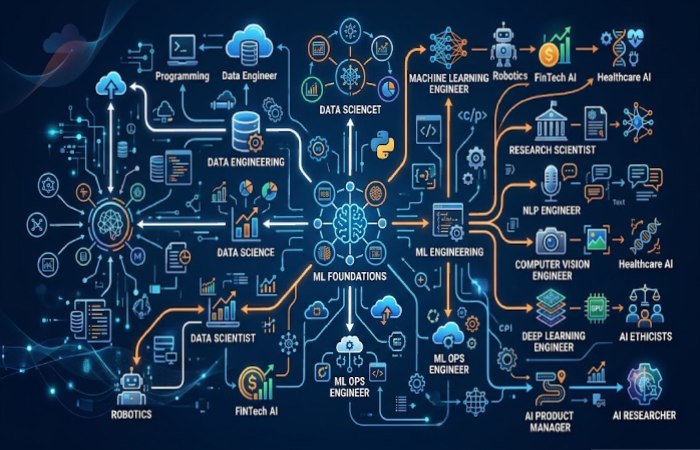
Machine learning is a diverse range of career roles involving working closely with machine learning engineers and specialists, enabling them to devise systems which can learn from data, make predictions, identify patterns and automate decision-making processes. As with most professional careers, depending on the specific job description, you could be developing strategies for data preparation and model building, building software systems that facilitate ML development, conducting research into how models can improve, or even be implementing ML systems for business applications and realizing its value.
Machine Learning is such a big field that there isn’t a single career track. Some roles will lean much more on the math and research side, others will be heavily coding- or cloud-focused, and some will apply ML in a specific domain.
Popular Career Paths in Machine Learning
The following roles represent some of the most common career opportunities in the field.
| Career Path | Primary Responsibilities | Key Skills |
| Machine Learning Engineer | Build, train, and deploy ML models | Python, ML frameworks, algorithms, cloud |
| Data Scientist | Analyze data and develop predictive models | Statistics, Python, SQL, visualization |
| AI Engineer | Develop AI-powered applications and systems | Deep learning, APIs, Python, AI frameworks |
| ML Research Scientist | Develop new algorithms and techniques | Mathematics, research, deep learning |
| MLOps Engineer | Deploy, monitor, and maintain ML systems | Cloud, DevOps, CI/CD, Kubernetes |
| NLP Engineer | Build systems that process human language | NLP, transformers, Python, deep learning |
| Computer Vision Engineer | Develop image and video-based ML solutions | Computer vision, OpenCV, deep learning |
| Robotics Engineer | Apply ML to autonomous machines and robots | Robotics, ML, computer vision, programming |
1. Machine Learning Engineer
Machine Learning Engineers: ML experts in practice. Machine learning engineers translate the concepts of the ML theory in concrete applications, create models, prepare data pipelines, implement models, and support with its integration to software development and scale with ML.
This would be a career for someone who loves to program and solve technical issues, having solid expertise in Python, Machine Learning Algorithms, Software Engineering, and any cloud platforms.
2. Data Scientist

Data scientists can discover knowledge and business value from data using methods of statistics, programming, machine learning etc. These methods are varied but may include: finding structures; build models for prediction; test a hypothesis; or simply show some finding to a business.
Data science could a good place for starters or persons that want have interaction from analytical and company-oriented duties.
3. AI Engineer
AI engineers are the ones who create applications where we utilise artificial intelligence technologies. Such work includes the production of generative AI, recommenders, conversational apps, and intelligent automation.
Good knowledge of deep learning frameworks, API, model integration, or software development is preferred.
4. Machine Learning Research Scientist
Research scientists work on making machine learning better. They design new algorithms, improve models structure, carry out experiments and publish studies.
This type of position is also research-heavy and typically requires higher education of computer science, math, statistics, or a relevant field to have that type of job.
5. MLOps Engineer
As firms are making more and more machine learning models available in production, they require people who will also be responsible for the infrastructure the model runs on. MLOps engineers will be individuals with combined ML knowledge and DevOps and cloud engineering skills.
These can include performing model deployment, automating model versioning, handling model monitoring, managing source control, and reliable ML pipeline management.
6. NLP and Computer Vision Careers
The field of machine learning is also expanding horizontally. NLP engineers specialize in understanding, processing and even producing human language and computer vision engineers in the field of visual data (images and videos).
These are the areas where you’ll be likely to find these individuals, i.e., search, virtual assistant, medical imaging, autonomous system, security and content analysis, etc. This also includes work involving language models and other AI systems that process and generate human language.
Skills Needed for a Machine Learning Career
The skills required depend on the role, but most professionals benefit from a combination of technical and soft skills.
| Skill Area | Examples |
| Programming | Python, SQL, Java, C++ |
| Mathematics | Linear algebra, probability, statistics, calculus |
| Machine Learning | Regression, classification, clustering, model evaluation |
| Deep Learning | Neural networks, transformers, computer vision |
| Data | Data cleaning, feature engineering, data visualization |
| Tools | Scikit-learn, PyTorch, TensorFlow |
| Deployment | Cloud platforms, APIs, containers, CI/CD |
| Soft Skills | Communication, problem-solving, teamwork |
How to Start a Career in Machine Learning
A practical learning path can make the transition into machine learning easier.
- Learn programming fundamentals: Beginning with Python & SQL and building good problem-solving abilities.
- Build mathematical foundations: Concentrate on statistics, probability, linear algebra, and the math’s of ML models.
- Study machine learning: Study supervised and unsupervised learning, model evaluation, features selection, feature engineering, and typical machine learning algorithms.
- Develop projects: Create projects based on real-world data such as recommenders, image classifiers, forecasting, or text classifiers.
- Learn deployment: Learn about the deployment of models into applications and in the production environments.
- Create a portfolio: Describe your showcase projects, technical explanations, code and measurable results either in a professional portfolio or a GitHub profile.
Which Machine Learning Career Is Right for You?
You can find the best career match for yourself on the basis of interest and current skills. If you love to code, you could target for becoming a ML engineer or MLOPS professional. If you like to study statistics and business insights, you could work as a data scientist. If you have research inclinations or high-level math skills, a research scientist could be better fit.
Machine learning is the broader field of technology that is continuously expanding its application across a variety of fields. If you take the time to build a strong foundation and invest in some practical experience, you’ll be able to pick the branch you want to focus on based on your individual vision.
Final Thoughts
There are many career options in machine learning, including roles in ML Engineering, Data Science, research, MLOps, NLP, Computer Vision, and AI Product. The perfect direction for you may be based on your current interest, technical skills, and your overall goals for the future. Don’t try to master everything there is to ML all at once.
Select a branch, develop basic skills, and build personal projects. And as you get more experienced in the field, you can focus your efforts more and identify the area you find most rewarding.