
Last Updated: September 1, 2026
Table of Contents
Introduction
Financial data is proving a profitable target for cyber criminals. Personal account details, payment details, passwords and transaction history may expose individuals and companies to fraud if not properly secured. In the case of the latter, AI has an important supporting role to play:
Artificial Intelligence to Keep Your Financial Data Safe. This doesn’t necessarily mean we’d just hand over the reins to the algorithm. AI could help your financial security to spot unusual activity, prioritizing your perceived threats, and even flag suspicious incidents quicker. This should not substitute secure passwords and multi-factor authentication, the latest software, nor secure financial practices.
This Article Belongs to AI Tools
What is Artificial Intelligence in Financial Data Security?
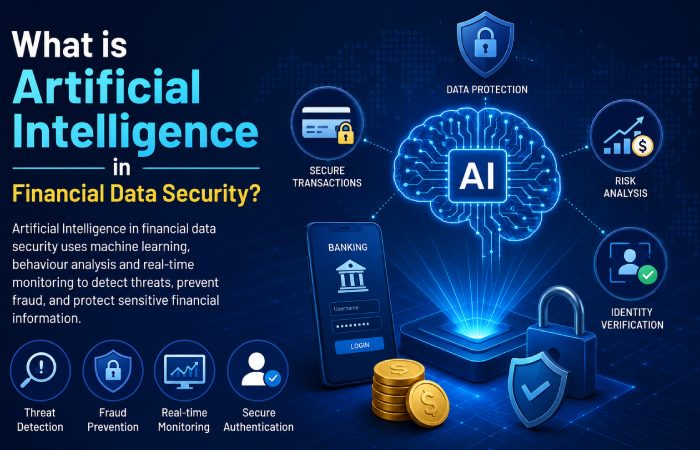
Artificial Intelligence for financial security, employ machine learning, pattern identification, and automated assessment tools to determine transactions and activities that may signal illegal fraud or intrusion.
For instance, if there are typically payments going through from one location only, but there are suddenly several new payments processed from various locations, a machine can spot this as a pattern and flag as potential issues by asking for more information or by giving out an alert.
The level of functionality differs greatly between financial institutions and software providers. In addition, AI models need the right data, testing, monitoring and governance for continued reliability.
NIST’s AI Risk Management Framework emphasizes security, resilience, privacy, accountability, and transparency as critical characteristics.
How Artificial Intelligence to Keep Your Financial Data Safe Works
A typical AI-assisted financial security workflow can look like this:
Transaction or login → Data analysis → Behaviour comparison → Risk scoring → Alert or verification → Human/system response → Continuous monitoring
AI can examine large amounts of activity much faster than manual review. It may look at transaction frequency, location, device characteristics, account behaviour and other signals to identify anomalies.
For instance, a legitimate transaction may fit a customer’s established behaviour, while an unusual sequence of transfers could receive a higher risk score. Depending on the financial service, the system may request additional authentication, temporarily restrict activity or send a notification.
Crucially, a risk score should not necessarily be the definitive proof of fraud. Normal users’ behaviour can deviate significantly from the expected pattern, so efficient systems will contain relevant thresholds and human/procedural reviews.
Key AI Technologies Used to Protect Financial Data
| AI capability | Security role | Practical example |
| Anomaly detection | Finds unusual behaviour | Identifying unexpected transaction patterns |
| Machine learning | Learns patterns associated with fraud | Flagging potentially fraudulent payments |
| Behavioural analysis | Compares current activity with normal behaviour | Detecting unusual login behaviour |
| Automated risk scoring | Priorities potentially risky events | Sending high-risk transactions for verification |
| Natural language processing | Analyses text and communications | Identifying suspicious messages or support interactions |
| Predictive analytics | Helps identify emerging patterns | Supporting fraud-risk monitoring |
Benefits and Limitations
AI can provide several useful advantages. It can process large datasets rapidly, continuously monitor activity and help security teams focus on higher-risk events. This can be particularly valuable for financial organizations handling enormous numbers of transactions.
Although it should be noted that the AI has its problems as well, with false positive being both a nuisance for valid clients and unreliable outputs from the poorly designed models. AI systems can also become targets themselves. NIST notes that AI security concerns can include data leakage, adversarial attacks and threats affecting the confidentiality, integrity and availability of systems and data.
For a broader look at the advantages and potential drawbacks of AI, see our guide to profits and risks of artificial intelligence.
| Advantages | Limitations |
| Rapid analysis of large datasets | Can generate false alerts |
| Continuous monitoring | Requires quality data |
| Can identify unusual patterns | Models require ongoing testing |
| Supports faster security responses | AI itself can introduce security risks |
| Helps security teams priorities events | Does not eliminate human judgement |
Practical Ways to Keep Financial Data Safer

The role that AI plays in our security is actually most effective in a layered approach to our defenses. Consumers should still implement the use of strong, unique passwords and multi-factor authentication when applicable. Multi-factor authentication is encouraged by the FTC as it adds additional barriers for those attempting to compromise an account even if a password has been obtained.
RBI also asks bank account holders in India not to disclose password, ATM PIN, OTP or CVV details. Customers are also advised to carry out digital banking through authenticated web links.
A sensible security workflow is:
- Use strong account credentials and avoid password reuse.
- Enable multi-factor authentication whenever your financial provider supports it.
- Keep banking and device software updated to reduce exposure to known vulnerabilities.
- Review transaction alerts and statements so unusual activity is noticed quickly.
- Avoid suspicious links and unverified applications that request financial information.
- Contact the financial institution immediately if an unauthorized transaction is discovered.
Realistic Expectations: Can AI Guarantee Financial Data Safety?
No. It is not within AI’s power to promise with absolute certainty that information will not be stolen or misused.
While AI helps to detect and respond, security is still dependent on a full technology stack. Poor password management, phishing and infiltration, vulnerable devices and bad access controls will remain threats, along with compromised third-party systems.
The best bet is a combination of AI, access controls, authentication, encryption, secure software development, surveillance methods, privacy measures, and human supervision. NIST similarly treats AI security and privacy as part of broader risk-management activities rather than as a standalone solution.
Understanding how AI is developing and influencing different areas of life can also provide useful context. Read more about how Artificial Intelligence can change the future.
AI Security Compared With Traditional Financial Protection
| Approach | Main strength | Main limitation |
| Passwords | Basic access control | Can be stolen or reused |
| Multi-factor authentication | Adds another verification layer | Depends on implementation |
| Encryption | Protects data from unauthorised reading | Does not prevent every account takeover |
| Traditional rule-based fraud detection | Clear predefined rules | May struggle with unfamiliar patterns |
| AI-assisted monitoring | Detects complex or changing patterns | Requires testing, governance and quality data |
| Human review | Provides contextual judgement | Slower and less scalable |
Who Benefits Most From AI-Based Financial Security?
Banks, payment providers, fintech firms, as well as organizations have a lot to gain, as they process great deal of transaction and security events.
Even individual customers benefit indirectly when their service provider uses AI-backed fraud detection. That said, it is up to individual users to stay diligent. A state-of-the-art security network can’t compensate for manually transmitting an OTP, keying in login details at a dodgy Web site, or ignoring bizarre bank-account activity.
Conclusion
Artificial Intelligence to keep your financial data safe by detecting anomalous patterns, identifying transactions and enabling quicker response times, AI can be an asset in reinforcing modern day financial security. However, its greatest role will be that of part of a larger security structure.
AI should therefore be viewed as a security aid rather than an absolute guarantee. Combining AI-assisted monitoring with multi-factor authentication, secure software, careful data handling, regular monitoring and human oversight provides a more realistic approach to protecting financial information.